
Essay
The bot is not the support system
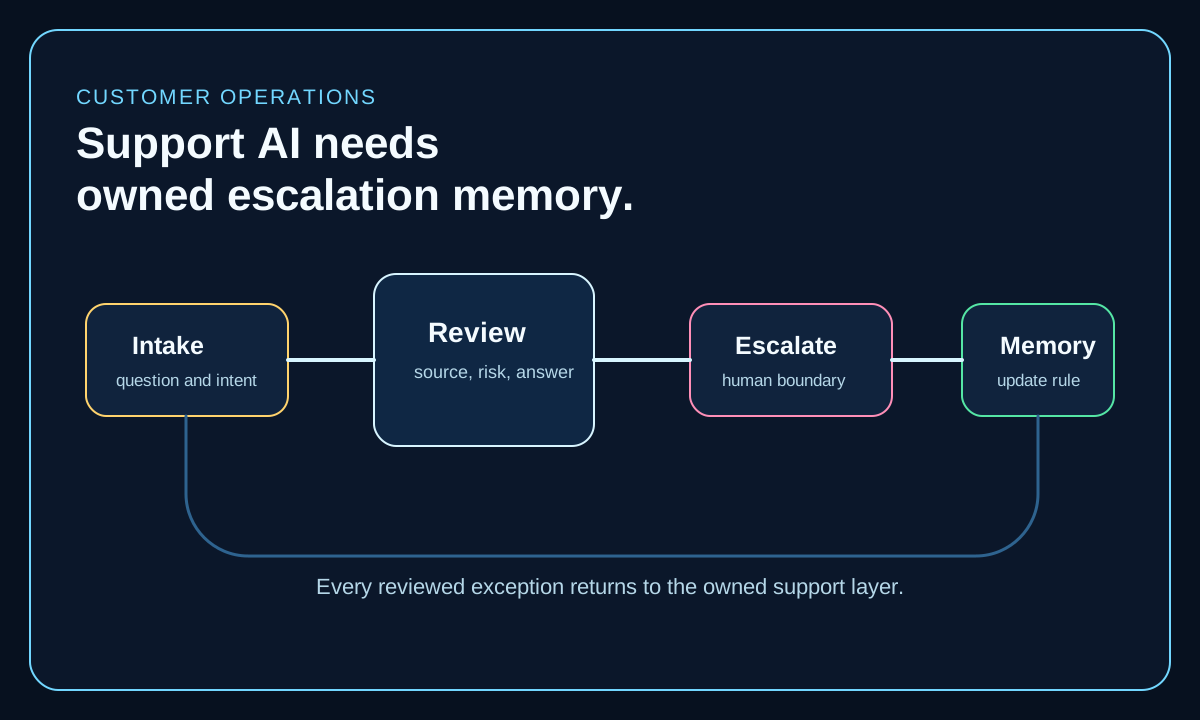
Many companies start customer support AI by asking whether a bot can answer common questions. That is a narrow test. The harder question is whether the company can keep learning from every answer, refusal, escalation, correction, and customer objection without trapping that knowledge inside a vendor console.
A support bot can reduce first-response time and still weaken the business if its rules, unresolved cases, source links, and improvement notes do not return to an owned operating layer. The customer sees the chat. The company needs the memory behind the chat.
Essay
Support work has to preserve exceptions
Support quality often improves through exceptions. A billing edge case, a refund refusal, a shipping delay, a service limitation, or a recurring product confusion can be more valuable than a hundred clean answers because it shows where the operating rule is incomplete.
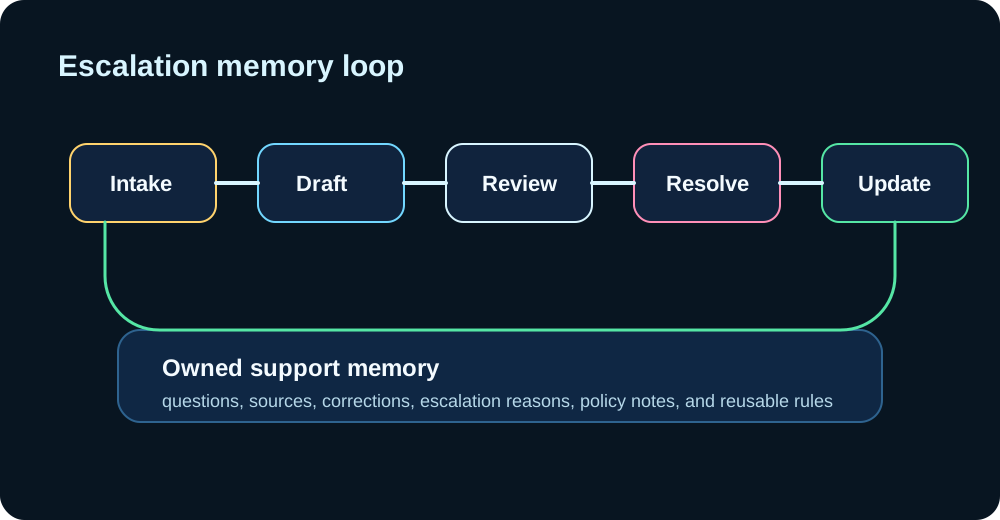
ChipOS treats those exceptions as memory objects. The system should capture what the customer asked, which source was used, what the AI drafted, what the operator changed, why escalation happened, and whether a policy, FAQ, product page, or internal note needs updating.
- What question triggered escalation?
- Which source or policy justified the answer?
- What did the human operator change before sending?
- Did the case reveal a missing public page, service note, or workflow rule?
- Where does the corrected pattern live before the next customer asks?
Essay
The owned layer sits above channels
A practical support system may use email, chat widgets, CRMs, help desk tools, forms, and external AI models. ChipOS does not require a company to reject those tools. It asks the company to keep the control layer above them.
That layer owns intent classification, knowledge routing, escalation rules, approval boundaries, output review, and the memory update after resolution. If a vendor changes pricing, a model becomes unavailable, or a channel is replaced, the support workflow can move without losing the operating intelligence.
Essay
A useful implementation starts small
The first version does not need a full autonomous support desk. A safer starting point is a reviewed support lane for one repeated workflow: website inquiries, onboarding questions, order status, supplier documentation, software setup, or service qualification.
For each ticket, the AI can draft from approved sources, label uncertainty, propose escalation, and return the final decision to a small memory table. After a week, the company should know which questions repeat, which claims need clearer public pages, and which answers should never be automated without human approval.
Essay
The business value is operational trust
Customer support AI becomes product-led when it improves the business, not only the chat transcript. It should reveal missing docs, update service pages, reduce repeated confusion, protect high-risk promises, and make the next operator faster without making them less accountable.
That is where ChipOS matters. The product is not a generic bot. It is the owned AI service layer that keeps customer-facing memory, review, escalation, and improvement under company control.
What to keep
The residue.
- Customer support AI should return memory to the company.
- Escalations and corrected drafts are valuable operating assets.
- The owned control layer should sit above chat, CRM, help desk, and model vendors.
- A reviewed support lane is a safer first implementation than a fully autonomous bot.
Operator view
Turn the essay into a company decision.
FAQ
Short answers for search and operators.
What is escalation memory in customer support AI?
Escalation memory is the owned record of why a support case needed review, which source or rule applied, what the human changed, and what should improve before a similar case appears again.
Does ChipOS replace a help desk or CRM?
Not necessarily. ChipOS can sit above existing support tools as the owned layer for routing, review, memory, and policy updates while the company keeps useful channels in place.
Which support workflow should a company automate first?
Start with a repeated, bounded workflow where approved sources are clear and human review is still easy, such as onboarding questions, service qualification, website inquiries, or standard setup requests.
Why is owned memory important for support quality?
Without owned memory, corrected answers and edge cases stay scattered across transcripts or vendor tools. With owned memory, the business can improve FAQs, service pages, policies, and future AI behavior.
Sources
Where this connects inside ChipOS.
- ChipOS Use CasesUsed for mapping customer support AI to practical founder, team, and operator workflows.
- ChipOS ServicesUsed for the managed implementation path when support automation needs setup and review.
- AI Audit Trails Need an Owned Evidence LayerUsed for the evidence and approval trail behind customer-facing answers.
- Private Company Search Is Not Company MemoryUsed for the distinction between finding past answers and owning the memory that improves future work.
Across the ecosystem
Comments
Leave a signal for Chip.
Add a correction, operator note, source context, or practical consequence. Comments enter moderated review before they become public.