
Essay
A chat log is not an audit trail
Many AI systems can show a transcript after the fact. That is not the same thing as an audit trail. Operators need to know which sources were used, what changed, who approved movement, what the model was allowed to touch, and where the final evidence now lives.
Once AI starts writing records, updating systems, preparing disclosures, or drafting decisions for review, the missing layer is not another prompt. It is owned evidence that can be inspected later by somebody other than the tool that created it.
Essay
The evidence layer keeps the work challengeable
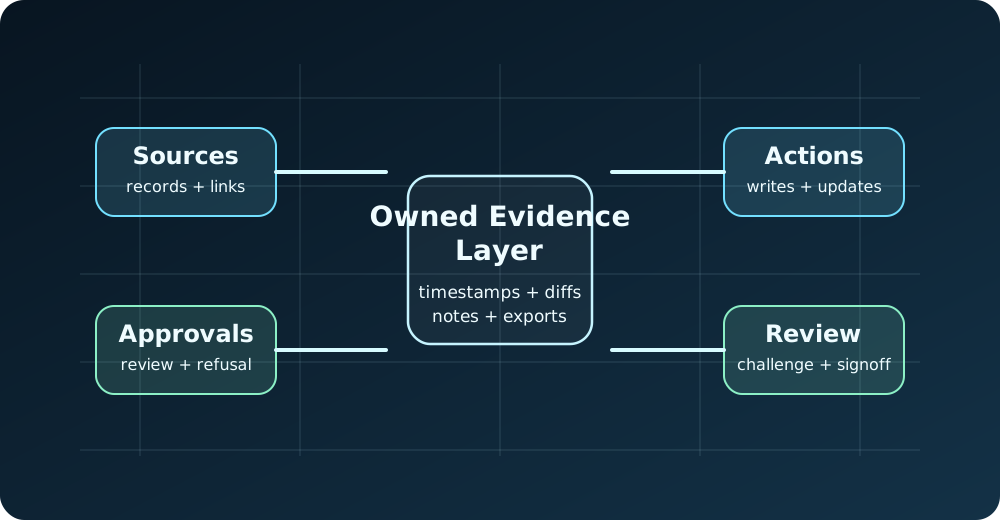
An owned evidence layer keeps the useful residue together: source links, approvals, comments, timestamps, changed fields, rejected actions, and the operator notes explaining why the work moved forward.
That matters because the real test often comes later. A manager, client, auditor, regulator, or internal reviewer may need to challenge the result after the model session is already over.
- Keep source material attached to the output.
- Store approvals and refusal points, not only final actions.
- Return reviewer notes and exceptions to owned memory.
- Make export and reconstruction possible if the tool changes.
Essay
This shows up first in regulated and proof-heavy work
The pattern appears anywhere proof has to survive: supplier documentation, internal policy workflows, customer support escalations, quality systems, sustainability reporting, finance review, and any task where a company may need to explain what happened later.
ChipOS treats this as an operating question. If the company cannot reconstruct the decision path without reopening one vendor's rented interface, then the workflow may be faster but it is not yet under control.
The same issue shows up in ESG disclosures, supplier evidence packs, carbon documentation, and other green-transition workflows where the claim matters only if the company can still prove it during procurement, financing, or audit review.
Essay
What an AI evidence pack should contain
A useful audit trail becomes operational when the company can define the minimum evidence pack that must return after every AI-assisted action. That pack should be light enough to maintain and strong enough to survive challenge.
The exact shape depends on the workflow, but the goal stays the same: a reviewer should be able to reconstruct what happened without depending on a model vendor's hidden session state.
- Source inputs and linked supporting files.
- Approval checkpoints and who cleared movement.
- Changed outputs, records, or disclosures.
- Exception notes, rejected actions, and human overrides.
- Reviewer comments that return to owned memory.
- An export and retention path that survives provider change.
Essay
A minimum evidence pack for ESG and supplier workflows
Sustainability and procurement teams usually discover the audit problem before everybody else because the claim already has a review path: a buyer asks for proof, a finance partner checks assumptions, or an auditor wants to see how a disclosure was assembled.
CBAM supplier data requests make the gap especially visible. A team may receive emissions files, supplier statements, methodology notes, and revision emails across several channels, then use AI to organize or draft responses. If the workflow cannot keep the source version, approval owner, exception note, and final submitted claim attached to the same evidence path, the speed gain becomes fragile at the exact moment a customer or reviewer asks follow-up questions.
The same boundary now matters for Digital Product Passport preparation. If product, repair, recycled-content, or supplier-facing fields move through AI-assisted drafting but no one can still show which product record, supplier file, approval owner, and caveat supported the field, the passport becomes a publishing shortcut instead of a governed product file.
That makes these workflows a strong first use case for an owned evidence layer. The question is not whether AI helped. The question is whether the company can still show what was claimed, which proof supported it, who approved movement, and what remained unresolved at the moment the claim left the system.
- The exact claim, disclosure line, or supplier statement being prepared.
- Linked source files, certificates, test data, or measurement records.
- The supplier, facility, or dataset version used for the draft.
- The approval owner who cleared release, submission, or customer send.
- Any exception note, override, or unresolved proof gap left in the workflow.
- A retention path that survives later lender, customer, or audit review.
Essay
Sustainable finance and CBAM reviews collapse drafting and due diligence
The pressure is higher in green-transition workflows because drafting and challenge now happen almost in the same motion. A lender, buyer, importer, or reporting partner may read the output as both communication and evidence request at once.
That changes what a useful AI workflow has to return. The team does not only need a faster draft. It needs the methodology version, source pack, approval owner, and unresolved caveats to remain visible when the review comes back.
This is why ChipOS treats CBAM, sustainable finance, and supplier-proof workflows as strong starting points for owned AI operations. They expose whether the system can preserve explanation, not only speed.
- Keep the methodology note or calculation basis attached to the draft, not in a separate inbox.
- Record which supplier file or facility dataset version the response relied on.
- Store the reviewer note that explains why a caveat was accepted, rejected, or left open.
- Return the submitted version and timestamp to owned memory so the next cycle starts from evidence instead of reconstruction.
Essay
Small teams should start with one evidence register
A smaller operator does not need a giant governance suite to begin. The first useful move is often one owned evidence register that follows the workflow each time AI touches a proof-heavy task.
That register can be simple as long as it is durable. It should identify the claim or response being prepared, link the source pack, name the approval owner, capture unresolved caveats, and record where the final output was published, sent, or submitted.
Once the same register follows website claims, supplier responses, and sustainability drafts, the company stops treating auditability as a separate project. It becomes part of the operating path.
- One workflow ID that stays attached from draft to publication or submission.
- One linked source pack instead of screenshots spread across chat and email.
- One approval owner and one visible exception field.
- One export path the company can still open after a vendor or tool changes.
Essay
Where the evidence chain usually breaks
Most teams do not lose control because one model answered badly. They lose control because the workflow crosses too many surfaces without carrying proof forward. A supplier statement starts in email, a draft moves through chat, someone updates a spreadsheet, then the final claim appears on a page or in a report with no durable explanation path behind it.
That is why the evidence layer has to sit across the workflow, not at the end of it. If the source trail only gets attached during final review, the system is already asking humans to reconstruct a process that should have been recorded as it moved.
- Supplier evidence arrives, but its version and source owner are not recorded.
- A model draft changes the claim, but the approval checkpoint stays in a separate channel.
- The website or disclosure goes live, but the proof pack does not travel with publication.
- A reviewer spots an exception, but the note never returns to the system memory for the next cycle.
Essay
Publishing and website claims need evidence too
The same control problem appears when a company publishes claims on its own website. A landing page, supplier page, sustainability update, or case study may be drafted quickly with AI, but the trust boundary shows up later when a customer, partner, lender, or regulator asks how that claim was assembled.
If the source files, editor notes, approval owner, and unresolved caveats disappear into chat history, the website becomes another weak evidence surface. The published sentence survives. The explanation path does not.
That is why ChipOS treats governed publishing as an evidence workflow whenever the page includes sourcing, carbon, quality, safety, or performance claims. The useful output is not only cleaner copy. It is a publishable page that returns with the proof pack still attached, especially when the same page is likely to be quoted by buyers, answer engines, or procurement reviewers before a human call begins.
- The exact live page that buyers, answer engines, or supplier reviewers are most likely to quote first.
- The exact claim version that went live.
- Linked support files, measurements, or supplier records behind the page.
- The editor or approver who cleared publication.
- Any visible caveat or unresolved proof gap that the next reviewer still needs to see.
Essay
Buyer diligence often starts on export and transition pages
For many companies the first real challenge does not arrive through a formal audit. It arrives when an importer, distributor, lender, or buyer lands on an export page, a sourcing page, or a transition note and treats the public copy as the first evidence request.
That is why green-trade and procurement pages matter so much. The page may look like marketing, but the reader is already testing whether the claim can reconnect to source files, review ownership, and a contact path that survives follow-up questions.
ChipOS treats those pages as operating surfaces, not only brand surfaces. If the page is part of supplier onboarding, CBAM preparation, financing trust, or cross-border buyer diligence, the evidence register should stay attached before the next rewrite or AI-assisted refresh.
- Treat export, sourcing, and transition pages as proof-heavy workflow outputs, not only marketing assets.
- Keep the support pack and approval owner close to each buyer-facing claim.
- Make the next human review path visible before answer engines quote the page out of context.
- Use the same evidence boundary for public pages, supplier responses, and finance-facing documentation.
Essay
Answer engines turn public claims into evidence requests
Search and answer engines now compress discovery and diligence into the same moment. A buyer, supplier, or lender may first see the claim as a quoted answer inside ChatGPT, Perplexity, or another answer surface before landing on the page itself.
That changes the risk boundary. The sentence is no longer only website copy. It becomes a portable claim fragment that can move ahead of the page context, the caveat, and the human reviewer who would normally explain what still needs proof.
ChipOS treats that as the same evidence problem, not a separate SEO tactic. If the quoted page cannot reconnect the claim to source files, approvals, visible caveats, and a real contact path, AI visibility can increase exposure faster than trust.
- Tie each quoted claim to one revision path and one support pack.
- Keep the visible caveat close to the claim instead of burying it in internal notes.
- Make the next human step obvious with a contact or review path.
- Review which proof-heavy pages answer engines are likely to quote before scaling AI-assisted publishing.
Essay
A website audit is often the fastest place to expose the evidence gap
Many smaller operators do not discover the owned-evidence problem inside a formal compliance program first. They discover it when the public site has to carry a service claim, sourcing statement, carbon explanation, certification note, or proof-heavy case study that no one can fully reconstruct a few months later.
That makes the website audit a practical starting point. The page is live, the trust pressure is visible, and the repair path is concrete: identify which claims matter, connect them to source files and approval owners, and make sure the update path remains usable after launch.
When the business already knows the website is the weak surface, the fastest operational move is to start with the live pages that carry claim risk, then map the same evidence logic back into the broader workflow.
- Start with the live pages that influence buyer trust, procurement, finance, or inquiry quality.
- List which claims need source files, owner approval, and visible caveats before the next update.
- Tie the page revision path to one durable evidence register instead of scattered CMS edits and chat history.
- Use the website audit as the first owned-system test before expanding automation across other workflows.
Essay
The deployment risk is fragmented evidence
The common failure mode is not only a bad answer. It is scattered residue: screenshots in chat, approvals in email, source files in a shared drive, and final updates inside a system that cannot explain how they were made.
That fragmentation turns every later review into archaeology. When evidence is split across rented tools, the workflow may look automated while the responsibility boundary stays weak.
- Provider session history can disappear or become harder to export.
- Approval evidence often lives outside the action that used it.
- Reviewer judgment gets lost when comments do not return to owned memory.
- Compliance claims get weaker when source-to-output reconstruction depends on manual digging.
Essay
Company use starts with one evidence-critical workflow
Do not begin by trying to govern every AI action at once. Pick one workflow where source integrity, approvals, and recovery matter. Define what evidence must return after each run and where that evidence will live.
That is often enough to reveal the real boundary: which tools can remain rented, which memory must be mirrored, and which approvals have to stay visible before the workflow can scale.
For many teams, the first useful test is not a chatbot. It is a proof-heavy workflow such as supplier onboarding, sustainability reporting, incident review, or any documentation chain that may later face external challenge.
If the workflow touches procurement or sustainability claims, define the evidence pack before the automation path. That keeps the later audit, financing, or customer challenge attached to the same operating layer instead of scattering proof across chat history and email.
Essay
The next move
Choose one workflow that would be difficult to defend without proof. Then define its source trail, approval checkpoints, exception notes, export format, and review owner before adding more autonomous behavior.
What to keep
The residue.
- A chat transcript is weaker than an owned evidence trail.
- Audit value comes from attached sources, approvals, and review notes.
- Regulated workflows need memory that survives tool changes and human challenge.
- A defined evidence pack turns abstract governance into a repeatable operating standard.
Operator view
Turn the essay into a company decision.
FAQ
Short answers for search and operators.
What is the difference between an audit trail and a chat history?
A chat history shows conversation. An audit trail shows the evidence around the action: sources, approvals, changes, timestamps, exceptions, and who reviewed the result.
Does every AI workflow need the same level of evidence?
No. Lightweight tasks can keep lighter records. The strongest evidence boundary is needed where output may affect compliance, customer trust, financial review, supplier claims, or public reporting.
Why should the evidence layer be owned?
Because the workflow has to remain inspectable even if the model, SaaS tool, or provider changes later. Ownership keeps the explanation path portable.
What should an AI evidence pack include first?
Start with the minimum chain that makes later review possible: source material, approval checkpoints, changed outputs, exception notes, reviewer comments, and an export path that does not depend on one vendor interface.
What is an AI evidence layer?
It is the owned system layer that keeps source files, approvals, changes, exceptions, reviewer notes, and exportable records attached to each AI-assisted action so the work can be challenged later.
Which workflow should a company govern first?
Start with one workflow that would create real exposure if the proof went missing later. Supplier onboarding, ESG reporting, carbon documentation, incident review, and customer-facing claims are usually stronger starting points than generic chat assistance.
Why do website and marketing claims need an evidence layer too?
Because AI-assisted publishing can move faster than the proof behind it. If a company cannot reconstruct the source files, approvals, measurements, and caveats behind a claim after publication, the page may look polished while the trust boundary remains weak.
Can one evidence layer cover ESG reporting, supplier claims, and website updates?
Yes, if the workflow returns the same core residue every time: source links, versioned support files, approval owners, changed claims, unresolved exceptions, and an export path that survives later review.
Why does this matter for supplier and sustainability workflows?
Because supplier claims, ESG documentation, and carbon evidence often face challenge long after the AI session ends. The workflow stays trustworthy only if the proof, approvals, and reviewer judgment remain reconstructable inside a system the operator controls.
Why do CBAM supplier data requests expose AI audit gaps so quickly?
Because CBAM workflows combine supplier files, emissions data, methodology notes, drafts, and later reviewer questions. If AI helps prepare the response but the workflow loses source versions, approvals, and unresolved caveats, the company ends up with a draft it cannot defend cleanly.
Why does this matter for sustainable finance and public claims?
Because lenders, procurement teams, and public-facing reviewers often test the same thing: whether the company can still show the source files, approval path, and unresolved caveats behind a green or performance claim after publication.
Why does Digital Product Passport work need the same evidence layer?
Because DPP fields often combine product data, supplier files, repair information, and public-facing claims. If AI helps structure the field but the team cannot still show the source record, approval owner, and unresolved caveat behind it, the passport becomes hard to defend later.
Why do answer engines make weak evidence more dangerous?
Because answer engines can quote a public claim before a buyer or reviewer ever sees the page context. If the claim cannot reconnect to source files, approvals, caveats, and a human path quickly, visibility increases exposure instead of trust.
What is the smallest evidence layer a small team can start with?
Start with one owned evidence register per workflow run: the claim or response being prepared, linked source files, the approval owner, unresolved caveats, the final published or submitted version, and an export path that stays available after a tool change.
Can a spreadsheet or simple register be enough at the start?
Yes. A small team can begin with one durable evidence register as long as it captures the claim, linked source pack, approval owner, unresolved caveats, final submitted or published version, and an export path that survives tool changes.
When should a company start with a website audit instead of a broader AI governance program?
Start with the website audit when the live site already carries sourcing, sustainability, quality, safety, or performance claims that affect trust, buyer review, or inquiry quality. That gives the company one visible evidence surface to repair before extending the same control logic into wider workflows.
How does an evidence layer help with lender, buyer, or procurement review?
It keeps the response tied to the methodology note, source version, approval path, and unresolved caveats that reviewers usually ask for next. That turns AI-assisted drafting into a defensible workflow instead of a faster but fragile document pass.
Why should export and green-trade pages be treated like evidence workflows?
Because buyers, distributors, and lenders often read those pages as the first diligence step. If the page cannot reconnect the public claim to source files, approvals, caveats, and a human review path, the company creates exposure before the real conversation even starts.
Sources
Where this connects inside ChipOS.
- ChipOS GovernanceUsed for the public control and responsibility boundary.
- ChipOS Use CasesUsed for mapping evidence requirements to real company workflows instead of abstract policy talk.
- ChipOS ArchitectureUsed for the memory, export, and deployment boundary needed to keep audit evidence durable.
- ChipOS Website ServiceUsed for publishing workflows where AI-assisted copy, claim review, and approval need to stay attached to owned evidence instead of disappearing into one CMS or chat trail.
- AI Search Visibility for ChatGPT and Perplexity Starts With Owned Website StructureUsed for the public-structure problem where pages become hard for buyers and answer engines to trust when claims, proof, and contact paths drift apart.
- GCE: How to Prepare for CBAM Supplier Data RequestsUsed as the applied workflow reference for supplier evidence, emissions files, reviewer follow-up, and submission-ready documentation.
- GCE: What Is Sustainable Finance?Used for the financing-side pressure where public claims and underlying proof have to survive lender, buyer, and audit scrutiny together.
- GCE: How to Prepare for Digital Product Passport (DPP) DataUsed for the product-data workflow where repair, supplier, circularity, and outward-facing product claims need one governed evidence boundary.
- GCE: Vietnam-Germany Green Trade OpportunitiesUsed for the export-facing diligence case where green positioning, sourcing trust, and cross-border buyer questions meet on public pages before a human review call happens.
Across the ecosystem
Comments
Leave a signal for Chip.
Add a correction, operator note, source context, or practical consequence. Comments enter moderated review before they become public.