
Essay
Visibility breaks before promotion begins
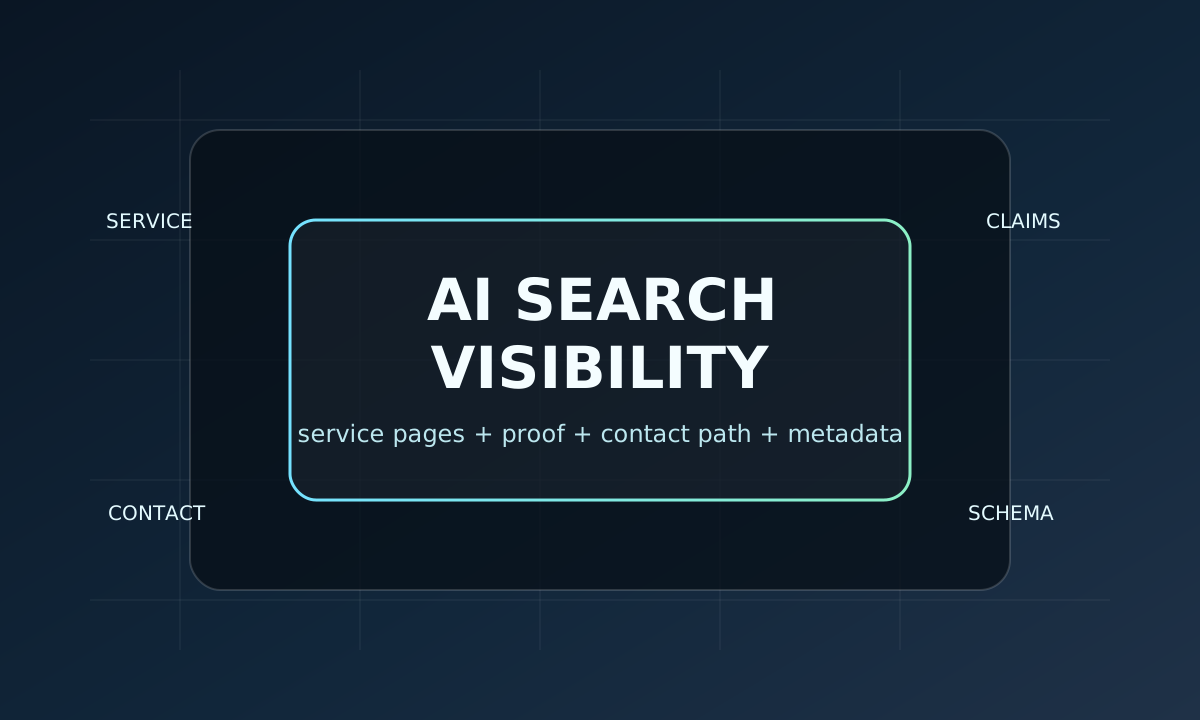
Many companies think they have a traffic problem when they really have a structure problem. The homepage is vague, service pages are thin, contact routes are scattered, and the most important claims sit in decorative sections that are hard for both people and machines to interpret quickly.
That weakness now shows up in more places than classic search. AI summaries, map results, snippet systems, and assistant-style answers all depend on whether the site exposes a clean account of what the company does, where it operates, which claims it can support, and what action a buyer should take next.
Essay
AI search visibility is an ownership question
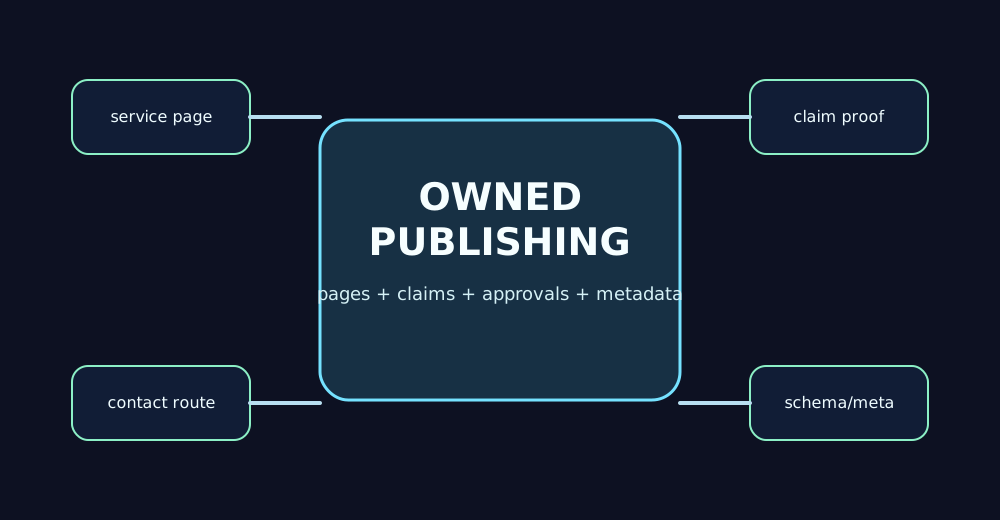
A site becomes AI-readable when the business can keep its service language, page hierarchy, contact path, trust signals, and revisions coherent over time. That is why ChipOS treats visibility as an operating question, not a copy trick.
If every update depends on an opaque builder, scattered plugins, or a CMS workflow nobody can reconstruct later, the company does not really own the structure that search systems are supposed to understand.
- Service pages should say what the company does in plain language.
- Public claims should stay tied to source files, caveats, and approval owners.
- Contact and conversion paths should be easy to find from every important page.
- Metadata, schema, and internal links should reinforce the real structure instead of improvising around it.
Essay
The hidden failure mode is claim drift
A website can look modern and still stay weak if its claims drift away from proof. This matters first for sustainability pages, sourcing statements, quality language, performance promises, and any other page that may later face customer, lender, or audit questions.
That risk grows when the page carries green, sourcing, or finance language. If a company says a material is circular, a supplier is responsible, or a project is finance-ready, the site structure should point back toward the evidence and approval path behind the claim instead of leaving the statement stranded as marketing copy.
Search visibility gets stronger when the page is not only cleaner but more stable. A company that can update a claim with its supporting evidence, approval note, and revision path intact is easier for people and machines to trust over time.
Essay
Proof-heavy pages fail in public before they fail in analytics
One weak page can create more damage than a month of soft traffic loss when it carries a claim that buyers, lenders, or regulated partners may challenge later. That is why AI-readable structure matters most on pages where discovery and due diligence now collide.
A CBAM supplier page is a useful example. If the public-facing explanation is cleaner than the underlying emissions records, methodology notes, owner approvals, or exception log, the page may attract attention before the team can defend what it says. The same pattern appears on sourcing pages, sustainable-finance pages, and certification-heavy service pages.
The same risk now applies to export-facing trust pages. If an EU buyer, procurement team, or financing partner encounters a supplier-readiness page through ChatGPT, Perplexity, or a forwarded answer summary, that page may become the first real diligence surface before anyone on the team joins the conversation. A site that cannot move from public claim to owner, evidence, and contact path quickly enough will lose trust on the exact page that should have created it.
The practical move is to treat those pages as operating surfaces, not isolated copy assets. The claim, the evidence path, the approval owner, and the contact route should all stay visible enough that a human reviewer can move from public language to supporting proof without guessing.
- Start with the page most likely to be cited, forwarded, or challenged by a buyer or reviewer.
- Keep the public claim connected to the underlying evidence and owner approval path.
- Treat export, compliance, and sustainability capability pages as quote targets instead of brochure leftovers.
- Use internal links to move readers from the claim page to the service, contact, or audit path that explains what happens next.
Essay
AI discovery now collapses the distance between search and due diligence
Buyers no longer move through a neat funnel where search happens first and scrutiny happens later. AI summaries, answer engines, procurement teams, and lenders can all encounter the same public page early, then test whether the service language, contact route, and claim logic still hold up under closer review.
That is why teams now ask how to show up in ChatGPT, Perplexity, and other answer engines. The practical answer is still structural. Those systems do not reward a separate vanity page nearly as much as they reward a site that exposes a clear service, a visible contact path, and claims that stay attached to evidence and revision history.
That means high-intent pages now need two kinds of structure at once. They need enough clarity to be understood quickly by AI systems and enough evidence discipline to survive the first serious question about sourcing, sustainability, finance readiness, or supplier proof.
For ChipOS, this is where website operations connect directly to governed publishing. The page should not only rank or appear in answers. It should also point back toward the owned evidence path that explains what was claimed, who approved it, and how it can be updated without losing trust.
- Service language should be understandable before a sales call.
- Proof-heavy claims should stay connected to an evidence and approval path.
- The contact route should remain visible when buyers want a human answer fast.
- Internal links should move readers from the claim to the workflow that supports it.
Essay
What an AI-readable website structure usually needs
The fix is rarely exotic. Most small and mid-sized businesses need a cleaner publishing system, stronger internal links, clearer service and proof pages, and a repeatable rule for how updates get approved.
The useful test is simple: if a buyer, AI system, or new operator landed on the site today, could they find the right page, understand the offer, see the trust signals, and follow a working contact path without guessing?
- One clear service page for each real offer.
- A homepage that names the business without jargon.
- Internal links between trust pages, use cases, and contact paths.
- Structured metadata that matches the actual page purpose.
- A recoverable workflow for claims, edits, and approval history.
Essay
Company use starts with one quoted-page audit
Most companies do not need a full rebuild to improve AI discovery. They need a scoped website audit that identifies which single page already carries the most buying intent, export scrutiny, or public-claim risk, then repairs that page before the confusion spreads across the rest of the site.
That page is often a service page, supplier-readiness page, sustainability page, or contact-bearing location page. When the page becomes easier to quote, easier to challenge, and easier to update safely, the business gets a better discovery surface and a cleaner operating rule at the same time.
- Audit the page most likely to be quoted by a buyer, lender, procurement team, or answer engine.
- Clarify the offer, owner, proof path, and human contact route before rewriting lower-value pages.
- Use the first repaired page to define how future claims, links, and updates should stay owned.
Essay
Fix the page answer engines will quote first
Do not begin by rewriting the whole site. Start with the page that already carries buying intent or public risk: the main service page, the product page that converts, the sustainability page that makes claims, or the location page that should bring in contact requests.
If the team specifically wants better visibility in ChatGPT, Perplexity, and other answer engines, the first repair should usually be the page most likely to be summarized, quoted, or forwarded by a buyer. That is often the core service page, the proof-heavy trust page, or the contact-bearing location page rather than the homepage.
Once that page is structurally sound, the business can extend the pattern across the rest of the site instead of spreading effort across dozens of low-value edits.
- Repair the core service page first when the business needs more qualified discovery and lead intent.
- Repair the location or contact path first when local discovery breaks after the click.
- Repair the claim-heavy trust page first when sourcing, sustainability, finance, or certification language may be challenged.
Essay
Quoted pages need an owner, a freshness signal, and one canonical path
A page can be structurally clear and still underperform if nobody owns its updates. Answer engines and buyers both run into the same failure mode: the page exists, but the offer, geography, proof, or contact route is no longer current enough to trust without hesitation.
That is why the page most likely to be quoted needs a named owner and a visible update rule. When pricing changes, service scope shifts, location coverage changes, or public proof gets revised, the canonical page should absorb the change instead of leaving several half-correct variants scattered across the site.
For high-intent service pages and proof-heavy trust pages, freshness is not a vanity metric. It is part of whether the business deserves the quote, the click, and the follow-up inquiry after an AI system surfaces the page to somebody who may act on it immediately.
- Assign one owner to each service page, location page, or claim-heavy trust page.
- Review the canonical page whenever the offer, coverage area, supporting proof, or contact path changes.
- Retire duplicate or thin variants that compete with the page you actually want cited.
- Keep the strongest page tied to one clear contact route and one current revision path.
Essay
Vendor or CMS changes can quietly break the page that was already winning
Teams often lose visibility right after a redesign, CMS change, agency handoff, or AI-tool migration because the page that used to carry the quote no longer keeps the same structure, canonical path, internal-link support, or update ownership. The page still exists, but the operating continuity behind it has been broken.
This is why ChipOS treats website visibility as part of the same ownership problem that shows up in model routing and workflow portability. If the business cannot preserve the page logic, proof path, contact route, and revision memory through a tooling change, the next vendor swap can erase trust faster than a better design can rebuild it.
The practical test is simple: after a platform or workflow change, can the team still point to one current page, one owner, one contact route, and one reconstructable history of what changed? If not, the migration probably created a visibility problem before anybody notices it in analytics.
- Keep the winning page slug, canonical rule, and strongest internal links stable during any rebuild or migration.
- Mirror service logic, proof notes, and approval ownership before moving content into a new builder or AI-assisted workflow.
- Check whether duplicate drafts, regional variants, or stale copies now compete with the page you actually want quoted.
- Validate the repaired page and one unrelated canary page after the migration so the new system does not quietly weaken the rest of the site.
Essay
The deployment risk is cosmetic modernization without publishing control
The common failure mode is paying for a prettier site while keeping the same weak content model underneath it. Pages still depend on brittle plugins, nobody knows which claim version is live, contact paths remain inconsistent, and internal links never get maintained.
That produces a modern-looking website with the same old structural confusion. Search systems remain uncertain, operators remain dependent on memory and workarounds, and every future update feels heavier than it should.
Essay
The next move
Pick one page with real business weight. Clarify its offer, proof, internal links, metadata, and contact path. Start with the page most likely to be quoted by a buyer, lender, importer, or answer engine, then decide which parts of the publishing workflow must stay owned so the next update improves trust instead of recreating confusion.
What to keep
The residue.
- AI visibility improves when the site structure is owned and understandable.
- Search systems trust coherent pages more than decorative copy blocks.
- Proof-heavy claims need publishing memory, not only better wording.
- High-risk pages should connect public language to evidence, approvals, and a human contact path before they attract scrutiny.
- A quoted-page audit usually creates more leverage than a full-site rewrite started too early.
- Quoted pages need a named owner, a freshness rule, and one canonical path.
- Start with one high-intent page before modernizing the whole site.
Operator view
Turn the essay into a company decision.
FAQ
Short answers for search and operators.
Is AI search visibility just another name for SEO?
It overlaps with SEO, but the practical test is broader. A site now has to be legible to search engines, AI summaries, map systems, and human visitors at the same time.
How do companies improve visibility in ChatGPT or Perplexity?
Usually by fixing the same structural issues that weaken human trust: vague service pages, weak proof, scattered internal links, and unclear contact routes. Answer engines are more useful to a business when the site already exposes a clean service structure that can survive scrutiny.
What is the first page a company should fix?
Start with the page that carries the most buying intent or public risk: usually a core service page, a location page, or a claim-heavy trust page.
Can a company improve ChatGPT or Perplexity visibility without rebuilding the whole site?
Usually yes. The higher-leverage move is to audit the one page most likely to be quoted first, repair its service language, contact route, metadata, and proof path, then use that page as the operating model for later updates.
What page should a small business audit first for ChatGPT or Perplexity visibility?
Usually the page most likely to be quoted back to a buyer: the main service page, the strongest location page, or the trust page carrying public claims. Fix the page that already carries intent or scrutiny before expanding the cleanup across the rest of the site.
Why does website ownership affect visibility?
Because visibility depends on whether the business can keep page language, internal links, claims, metadata, and updates consistent over time instead of losing control to brittle tools or unclear workflows.
Do sustainability or sourcing pages need a different treatment?
Yes. Those pages often need stronger proof handling because the claim may be challenged later by customers, partners, lenders, or auditors.
What if the page that gets quoted first is an export, sustainability, or compliance page?
Treat it as a trust and operating page, not only a marketing page. The public claim, owner, contact route, supporting proof, and update path should stay coherent enough that a buyer or reviewer can move from summary to human follow-up without hitting ambiguity.
What should a proof-heavy page include for AI discovery and buyer trust?
It should make the offer clear, keep the contact path obvious, connect public claims to the evidence and approval workflow behind them, and use internal links that help both people and AI systems reach the supporting service or trust pages without guessing.
How often should a service or claim-heavy page be reviewed for AI visibility?
Review it whenever the offer, location coverage, pricing logic, contact route, or supporting proof changes. Even without a major change, high-intent pages should still have a recurring owner check so the canonical page stays current enough for both AI systems and human buyers to trust.
Can a site look modern and still stay weak for AI discovery?
Yes. A visual refresh does not solve vague service language, missing proof, inconsistent internal links, weak metadata, or a broken contact path.
Why can ChatGPT or Perplexity visibility drop after changing agencies, CMSs, or AI tools?
Because the visible page may survive while the structure that made it trustworthy does not. Canonical rules, internal links, contact routes, proof notes, and update ownership often break during migrations, which leaves answer engines and buyers with several half-current variants instead of one strong page to quote.
Sources
Where this connects inside ChipOS.
- ChipOS Website ServiceUsed for the conversion path and the operational framing around website rescue, modernization, and AI visibility.
- ChipOS Use CasesUsed for mapping publishing structure back to an owned operating layer instead of treating the site as an isolated marketing asset.
- ChipOS ArchitectureUsed for the system view that connects page structure, approval flow, and publishing memory back to an owned operating boundary.
- AI Audit Trails Need an Owned Evidence LayerUsed for pages where claims, proofs, approvals, and later review need to remain reconstructable after publication.
- AI Pricing Volatility Makes Model Routing an Ownership DecisionUsed for the portability argument that provider, tooling, and workflow changes become risky when the business does not own the decision layer and migration continuity.
- GCE: Vietnam-Germany Green Trade OpportunitiesUsed for export-facing pages where public sustainability language, buyer diligence, and trade-readiness claims now meet AI discovery before a human sales conversation starts.
Across the ecosystem
Comments
Leave a signal for Chip.
Add a correction, operator note, source context, or practical consequence. Comments enter moderated review before they become public.