
Essay
Better copy is not enough
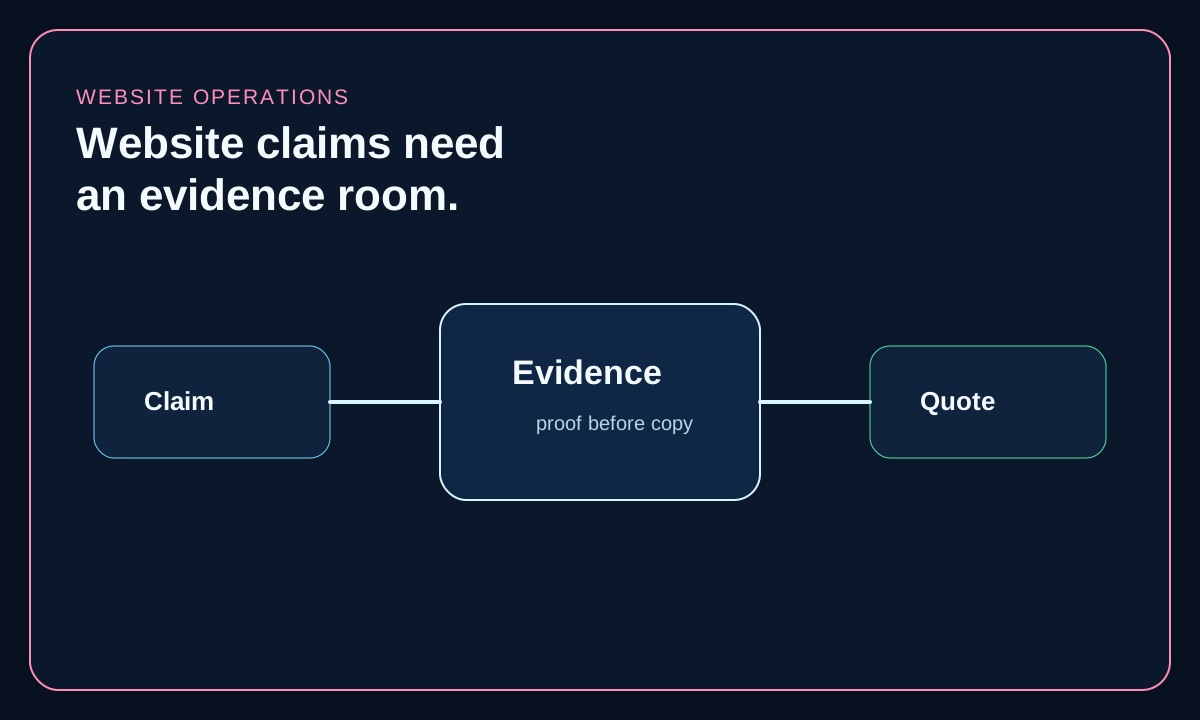
Many website fixes focus on clearer language. That helps, but proof-heavy pages need more than better copy. A sustainability claim, supplier promise, audit statement, service guarantee, or technical capability page should be connected to the evidence that supports it.
If the claim gets quoted by a buyer, search engine, ChatGPT, Perplexity, or procurement reviewer, the company needs to know what stands behind the sentence.
This is especially true on export, sourcing, transition, and ESG pages where the public wording can become the first diligence step before any human call happens.
Essay
The evidence room sits behind the page
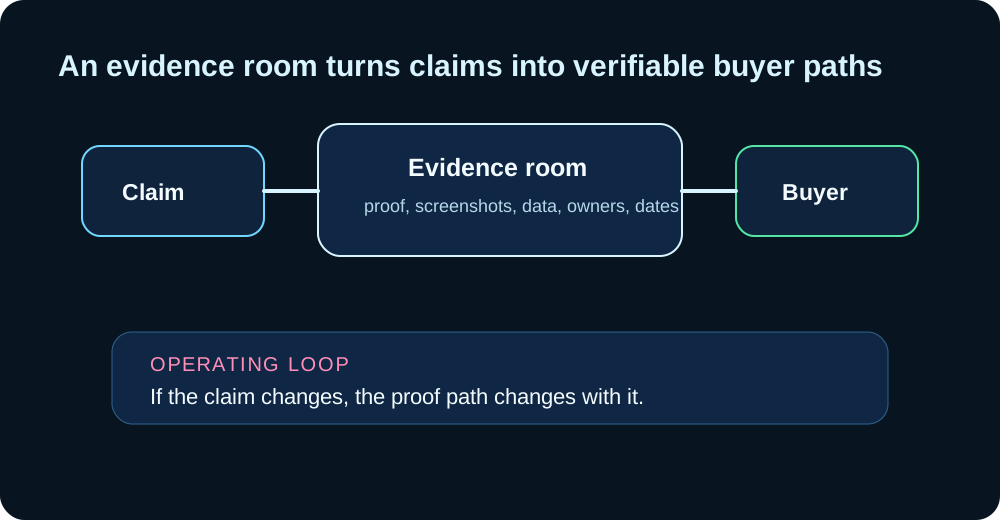
An evidence room is the owned record behind a public page. It does not have to be public itself, but it should be organized enough that the team can respond when a claim is challenged or needs updating.
The room connects sources, approvals, caveats, version history, and the person who can answer. It turns public content into an operating surface instead of a fragile marketing artifact.
- Claim: what the page says.
- Source: what supports the claim.
- Approval: who accepted the wording.
- Caveat: what should not be overstated.
- Owner: who answers when a buyer asks.
Essay
AI visibility makes evidence rooms more important
Answer engines can quote or compress public pages. That increases the value of clear structure, but it also increases the cost of vague proof. If the original page is unsupported, the quoted version may become even weaker.
An evidence room helps the company keep public claims aligned with reality after AI systems, buyers, or partners repeat them.
Essay
Green transition pages usually expose the evidence gap first
The first page that proves the evidence-room problem is often not a general homepage. It is a proof-heavy page tied to sustainability, sourcing, carbon, circular materials, supplier data, or transition finance.
Those pages attract a different kind of reader. Importers, lenders, procurement teams, auditors, and answer engines treat them less like marketing and more like a claim surface that should reconnect to source files, assumptions, and review ownership.
That makes them a strong starting point for ChipOS website work. If the team can keep one green-transition page tied to evidence, caveats, and a visible owner, the same operating pattern can extend across service pages, case studies, and broader public claims.
- List the exact public claim the page is making.
- Attach the source pack, methodology note, or supplier file behind the wording.
- Name the approver who can still defend or revise the sentence later.
- Keep one visible caveat field so the page does not outrun the proof behind it.
Essay
AI literacy decides whether the room stays human-led
An evidence room is not only a content structure. It is also a literacy structure. The team needs to know where model fluency ends and human responsibility begins.
Without that literacy, AI-assisted copy can look finished before anyone checks the source quality, the caveat, or the approval boundary. The company then ships a stronger sentence with a weaker understanding of what remains human.
That is why ChipOS treats website evidence rooms as an operating bridge between AI visibility and AI judgment. The page should not only rank or convert. It should remain challengeable by the people who own the claim.
Essay
The next move
Take the most important service, supplier, or sustainability page and create a small evidence room behind it. Start with five claims, five sources, one approval owner, and one update rule.
If the page is already influencing buyer trust or AI visibility, fix the evidence room before commissioning another round of copy polish.
What to keep
The residue.
- Proof-heavy website claims need evidence rooms.
- A claim should connect to source, approval, caveat, owner, and update path.
- AI visibility makes unsupported claims more fragile, not less.
- The first evidence room should sit behind the page buyers are most likely to quote.
Operator view
Turn the essay into a company decision.
FAQ
Short answers for search and operators.
What is a website evidence room?
It is an owned record behind a public page that stores the source files, approval notes, caveats, owner, and update path for important claims.
Does the evidence room need to be public?
Not always. Some evidence can remain internal, but the company should be able to retrieve it quickly when a buyer, partner, auditor, or AI visibility review requires support.
Which website claims need evidence first?
Start with claims that affect trust: sustainability, sourcing, compliance, service capability, security, finance, project results, or any statement a buyer may quote.
Why do ESG and supplier pages need stronger evidence rooms than generic marketing pages?
Because those pages often become the first diligence surface for buyers, lenders, importers, or auditors. The wording has to reconnect cleanly to source files, methodology notes, caveats, and an approval owner.
Why do answer engines make unsupported website claims riskier?
Because answer engines can quote the claim before the reader sees the full page context. If the company cannot reconnect that quoted sentence to proof and a human review path quickly, visibility increases exposure instead of trust.
Sources
Where this connects inside ChipOS.
- ChipOS Website ServiceUsed for the proof-heavy website audit and repair path.
- AI Visibility Audits Should Start With the Page Buyers QuoteUsed for the quoted-page audit logic.
- AI Audit Trails Need an Owned Evidence LayerUsed for the owned evidence layer behind public claims.
- GCE: How to Build an ESG Evidence PackUsed for the proof-pack logic behind sustainability and disclosure pages.
- Age for AI: The AI Literacy CrisisUsed for the judgment boundary between fluent AI wording and accountable human review.
Across the ecosystem
Comments
Leave a signal for Chip.
Add a correction, operator note, source context, or practical consequence. Comments enter moderated review before they become public.