
Essay
A polished lead can still be the wrong lead
An automated desk reviews several valid signals. One is current and operationally important but has no source image. Another is months older, fits a preferred category, and arrives with attractive media. If the selector optimizes presentation across the entire archive, the older item can win before freshness is considered.
Nothing in that result has to be fabricated. The source can be real, the image usable, and the category relevant. The failure is ordering: a presentation advantage was allowed to override the question the system was supposed to answer now.
For an owned AI control layer, that is a state problem rather than a copy problem. Freshness should define the eligible set before visual polish or lane preference chooses what leads.
Essay
Freshness is a boundary before it is a score
Many ranking systems mix recency, relevance, evidence, category, media, and engagement into one score. That can be useful after eligibility is clear. It is fragile when a strong preference in one dimension can compensate for a source that is no longer current enough for the task.
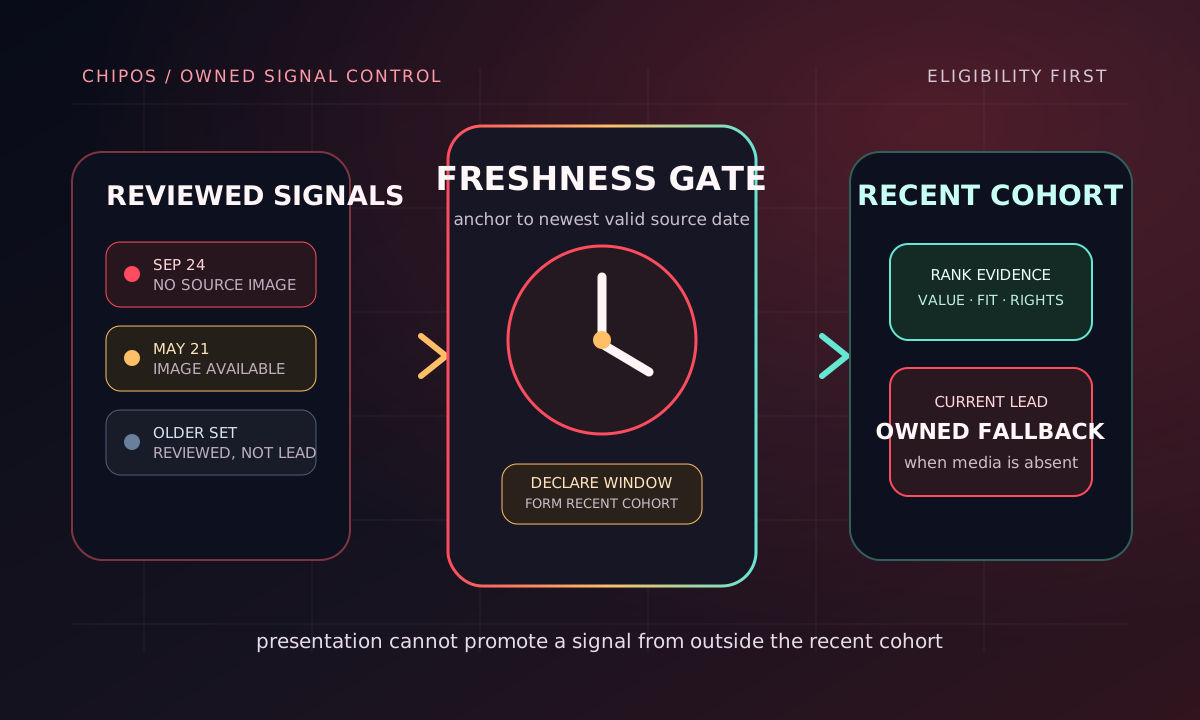
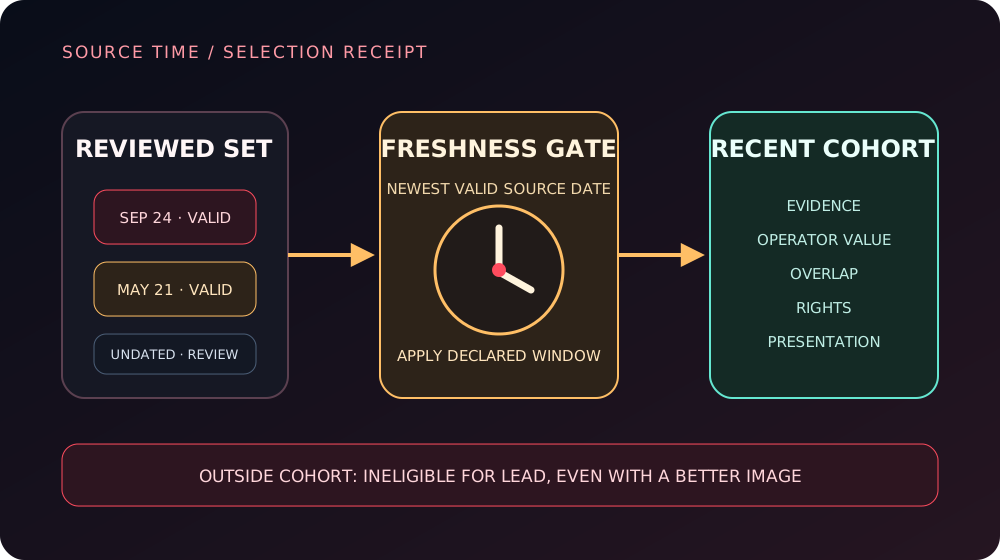
The proposed ChipOS pattern uses a freshness cohort. Find the newest valid source date in the reviewed set, define a bounded lookback from that source date, and exclude older items from lead selection. Existing preferences then operate only inside the recent cohort.
The window is an operator decision, not a universal constant. A breaking security change may need hours. A standards update may remain useful for months. The important control is that the window is explicit, inspectable, and tied to the job's purpose.
- Identify the newest valid source date among reviewed candidates.
- Apply the task's declared freshness window to create an eligible cohort.
- Keep invalid, undated, or unverifiable records outside the automatic lead path.
- Rank the cohort for evidence quality, operator value, fit, and distinct contribution.
- Apply image and presentation preferences without letting them reach outside the cohort.
Essay
Build the cohort before ranking the presentation
The control can be expressed as two gates. Gate one is temporal eligibility. Gate two is selection inside the eligible set. This makes the decision legible: an operator can see whether an item lost because it was stale, weakly evidenced, duplicative, poorly matched, or simply less useful than another recent candidate.
NIST's AI Risk Management Framework does not prescribe this algorithm. It does, however, emphasize that context, intended use, assumptions, limitations, data selection, and system metrics should be understood and documented. The freshness cohort is one practical way to make those contextual choices visible in a content-selection workflow.
Essay
A concrete case: the recent item had no image
In one ChipOS news workflow, a reviewed item dated 24 September described a current infrastructure signal but did not provide a suitable source image. An older reviewed item dated 21 May belonged to a preferred lane and did have an image. A global image-and-lane preference selected the May item as the lead.
The narrow repair was not to invent a new ranking system or copy media from the recent source. The selector first formed a 14-day cohort anchored to the newest reviewed source date. The existing ranking then ran inside that cohort. The September item remained the lead and the interface used the site's already-owned fallback visual.
This is an implementation example, not proof that fourteen days is correct for every desk or task. It demonstrates the control boundary: the current signal stayed current even when the older signal was easier to present.
Essay
An owned fallback is a control feature
A missing image should not force the system to choose between stale information and questionable media use. An owned fallback gives the workflow a third path: preserve the strongest eligible signal while displaying a visual whose rights and provenance are already known.
That fallback should be designed as part of the system, not generated opportunistically from a source's protected artwork. It can show the site's identity, the content category, or a neutral evidence pattern without implying that it came from the original publisher.
The receipt should state that the fallback was used and why. This keeps presentation honest and lets the owner distinguish source material from site-owned framing.
Essay
Use source time, not the current clock
A deterministic selector needs a stable temporal anchor. If it evaluates the same reviewed set against the current clock, the cohort can change simply because the job ran later. That makes reproduction and audit harder, especially when a delayed worker or rebuild processes an unchanged dataset.
Anchoring the cohort to the newest valid source date makes the decision reproducible for that candidate set. RFC 3339 provides an interoperable Internet timestamp format, but it does not decide which timestamp is authoritative or how long a freshness window should be. The workflow still has to distinguish publication time, update time, discovery time, and local ingestion time.
When source time is missing or contested, the honest state is unknown. The item can move to review instead of receiving a synthetic timestamp that makes it look current.
Essay
Keep a small selection receipt
A selector becomes governable when it can explain its inputs without preserving unnecessary private conversation. The W3C PROV-O recommendation supplies a general vocabulary for representing and exchanging provenance across systems. It does not prescribe a news-ranking receipt, but it supports the broader practice of linking an output to the entities, activities, and responsible agents that produced it.
For this workflow, a compact receipt should let a human reconstruct why the lead was eligible, why competing items were excluded, and where the displayed media came from.
- Candidate identifiers, source URLs, source dates, and review status.
- The newest valid source date and the declared freshness window.
- The resulting cohort and each excluded item's exclusion reason.
- The ranking inputs used inside the cohort, including overlap and operator value.
- The chosen visual, its rights status, and whether it is source media or an owned fallback.
- The final lead, selector version, execution time, and any unresolved facts.
Essay
Implementation checklist for an owned selector
Start with a small reviewed set and a reversible publication surface. The purpose is not to automate more output. It is to keep the reason for selecting one signal under owner control.
- Define the task's freshness rule before loading presentation preferences.
- Normalize source timestamps and retain their original values and time zones.
- Separate source publication, source update, discovery, review, and ingestion times.
- Reject or review records whose authoritative source time cannot be established.
- Build the eligible cohort before applying category, lane, image, or layout preferences.
- Deduplicate against current news and blog content before ranking novelty.
- Use only media with verified rights or an owned fallback with accurate alt text.
- Record excluded items and reasons without turning the receipt into a raw conversation log.
- Test boundary dates, equal dates, missing dates, future dates, empty cohorts, and delayed runs.
- Let the owner change the window and see the resulting cohort before consequential publication.
Essay
What this pattern cannot promise
A freshness cohort does not prove that the newest item is true, important, complete, or safe to publish. It cannot replace source verification, rights review, editorial judgment, or a check for meaningful overlap with existing work.
It also does not make one window correct across all domains. The useful claim is narrower: stale presentation advantages cannot silently override a declared recency boundary, and the owner can inspect the evidence behind the lead decision.
What to keep
The residue.
- Create the recent evidence cohort before applying presentation preferences.
- Anchor reproducible selection to verified source dates, not the current clock.
- Do not let an older image-bearing item displace a stronger recent signal.
- Use an owned visual fallback when source media is absent or rights are unclear.
- Return a receipt that exposes eligibility, exclusions, provenance, and unresolved facts.
Operator view
Turn the essay into a company decision.
FAQ
Short answers for search and operators.
Does the newest source always become the lead?
No. Freshness defines eligibility, not final quality. Inside the recent cohort, the system still evaluates evidence, operator value, duplication, relevance, rights, and the task's declared purpose.
Why not include recency in one weighted score?
A weighted score can allow a strong image, preferred category, or other presentation advantage to compensate for staleness. A cohort makes the temporal boundary explicit before those preferences operate.
What should happen when the strongest recent item has no image?
Keep the stronger eligible item and use a verified site-owned fallback. Do not copy unlicensed media or promote an older item merely because it has a convenient image.
Is a 14-day freshness window a ChipOS standard?
No. Fourteen days was the bounded rule in one implementation. Each workflow should define and test a window appropriate to its domain, update speed, risk, and human review process.
Sources
Where this connects inside ChipOS.
- NIST Artificial Intelligence Risk Management Framework 1.0Primary framework source for documenting context, intended use, assumptions, limitations, data selection, and monitoring. It does not prescribe or certify this ChipOS selection pattern.
- W3C PROV-O: The PROV OntologyPrimary W3C recommendation for representing and interchanging provenance information across systems. It does not prescribe editorial ranking or freshness policy.
- RFC 3339: Date and Time on the Internet: TimestampsPrimary Internet standard for an interoperable timestamp format. It does not determine source authority, freshness windows, or editorial relevance.
Across the ecosystem
Comments
Leave a signal for Chip.
Add a correction, operator note, source context, or practical consequence. Comments enter moderated review before they become public.