
Essay
A transcript is input, not authority
A conversation can contain a clear sentence and still leave the action unclear. “Fix the page” may refer to a draft, a live route, a mobile layout, or one sentence. “Send it” may mean save a draft, share it privately, or publish it. Tokenizing those words makes them processable by software; it does not settle which interpretation the person intended.
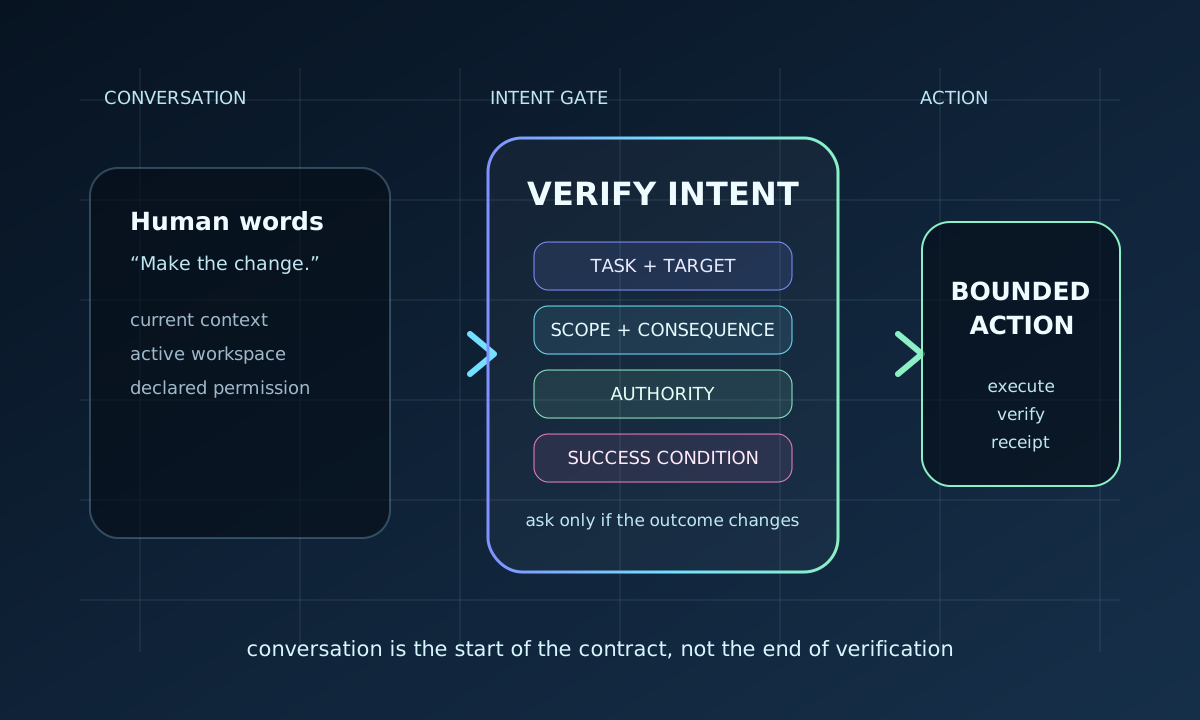
It also does not establish authority. A user may be allowed to read a workspace but not publish it, discuss a contract but not sign it, or suggest a deployment without approving production access. The technical bridge between language and action therefore needs more than prompt parsing. It needs a bounded task contract.
Essay
Intent verification is not mind-reading
ChipOS treats intent verification as an operational design proposal. The system uses the current conversation, the recognized user pattern, the active workspace, recent task state, and declared permissions to form a candidate interpretation. It does not claim access to a hidden inner state, permanent learning, or a universally correct reading of the person.
The distinction matters. Pattern recognition can reduce repeated questions, but it should never become silent authority. A familiar preference can guide a low-risk choice; it cannot automatically authorize a deployment, disclosure, purchase, deletion, or public statement.
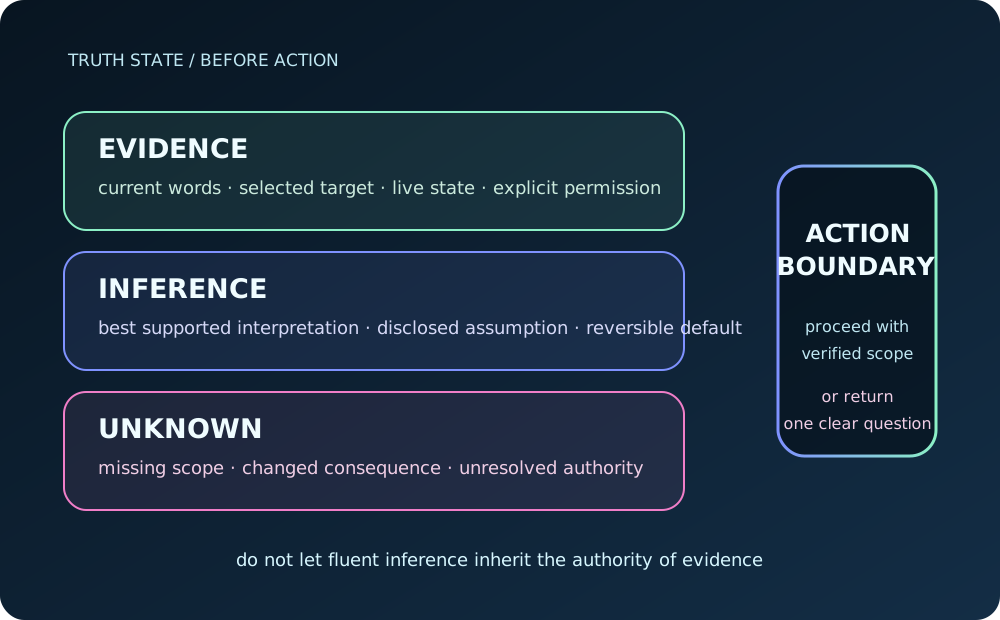
- Evidence: words, selected files, active route, current system state, and explicit permission that can be checked now.
- Inference: the system's best interpretation of what the person probably means.
- Unknown: missing target, scope, consequence, authority, or success condition that could change the result.
Essay
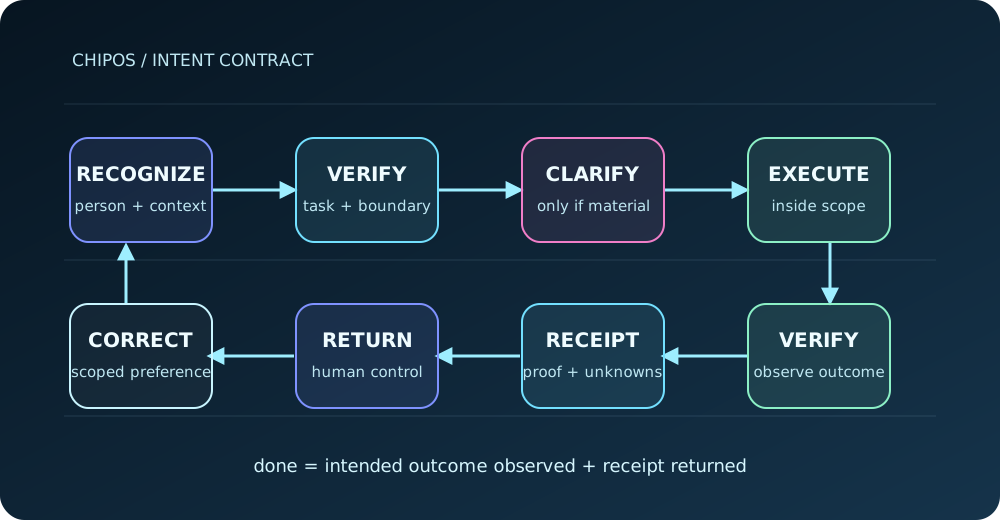
The five-stage bridge from conversation to action
The bridge is a sequence, not a single confidence score. Each stage produces a compact state that the next stage can inspect. If a material boundary remains unresolved, the system pauses before execution instead of hiding the gap inside fluent language.
- Recognize the user pattern and current context: who is speaking, which workspace is active, what changed recently, and which source is authoritative.
- Verify task, target, scope, consequence, and authority when any of them could materially change the action or its impact.
- Ask only when ambiguity changes the outcome; otherwise state the bounded assumption and continue.
- Execute inside the agreed boundary, using the smallest action that can satisfy the task.
- Verify the observed result and return a receipt with what changed, what did not, and what remains unknown.
Essay
Ask only when ambiguity changes the outcome
Constant clarification is not control. It can turn a useful personal AI into a form that asks the person to restate every preference on every turn. The better rule is consequence-sensitive clarification: ask when two plausible interpretations would produce materially different results.
If the ambiguity affects only a reversible presentation detail, the system can choose a conservative default and disclose it in the receipt. If it changes the target, publishes data, spends money, alters access, removes information, or creates a legal or reputational consequence, the system should verify before acting.
- Do not ask: “Should I use 16 or 18 pixels?” when the existing design system provides the answer.
- Do ask: “Do you mean the private preview or the live production page?” when the target changes the consequence.
- Do not ask again when the person already approved the exact bounded action and nothing material changed.
- Do ask again when the live state, recipient, amount, permission, or public audience changed after approval.
Essay
A concrete workflow: repair one live service page
Imagine the instruction: “Make the service headline smaller and push it live.” The personal AI first recognizes the current ChipOS conversation and the referenced service page. It then checks whether the visible problem belongs to one article, one shared component, or the global type system. That establishes the candidate task and target.
Before editing, it verifies the production source path, active image, exact owning file, unrelated drift, and permission to deploy. If the local file is stale, the system patches from live. If a shared rule would change unrelated pages, it narrows the selector or stops for clarification.
- Task: rebalance one headline and visual, without changing copy.
- Target: the named live route and its article-scoped hero rule.
- Scope: one stylesheet selector; no navigation, metadata, or other article changes.
- Consequence: public production change with rollback required.
- Authority: explicit owner approval for that route and change.
- Success condition: desktop and mobile composition verified, target HTTP 200, unrelated canary unchanged.
Essay
Keep evidence, inference, and unknown separate
A strong intent bridge does not erase uncertainty. It labels uncertainty so the executor cannot mistake a plausible interpretation for a verified instruction. The receipt should show which facts were observed, which assumption was used, and which unknowns were left outside the action.
NIST's AI Risk Management Framework emphasizes context, documented roles, human oversight, and review. Its Generative AI Profile also describes confabulation as confidently presented erroneous or false content. These sources support the need for checks and documentation; they do not validate this exact ChipOS sequence or guarantee that it will detect every mistake.
- Evidence: the live route returns 200, the owner named the target, and the active file hash was checked.
- Inference: “smaller” likely means restoring balance rather than minimizing the title.
- Unknown: whether the owner prefers a specific numeric type scale if no visual reference was supplied.
- Bounded move: apply the smallest reversible adjustment, verify it visually, and expose the chosen scale in the receipt.
Essay
Started is not done
A task can be parsed, queued, edited, built, or deployed and still be incomplete. Those are process states. Completion is an outcome state: the requested result must be observed on the intended target, inside the approved boundary.
For a file task, verification may be a diff and test. For a live page, it may require public HTTP, canonical metadata, desktop and mobile rendering, and an unrelated canary. For a message, it may require a confirmed draft or delivery state. The receipt should name the evidence appropriate to the consequence.
- Started: the system accepted a candidate task.
- Executed: an action was attempted inside the boundary.
- Verified: the intended result was observed and protected surfaces still work.
- Done: the verified result and remaining uncertainty were returned to the person.
Essay
Implementation checklist for an owned intent layer
The intent layer should be inspectable and portable. It belongs in the operator's control plane, not only inside a model session that disappears after the answer. A practical implementation can remain compact while still making authority and completion explicit.
- Bind every task to an authenticated human, active workspace, and timestamped conversation segment.
- Store the candidate task, target, allowed actions, excluded actions, consequence class, authority source, and success condition.
- Separate verified observations from inference and unresolved unknowns.
- Escalate only ambiguities that change the outcome or authority boundary.
- Use least-action execution: smallest file set, narrowest permission, reversible operation, explicit stop condition.
- Record before state, action, after state, verification evidence, canary result, and rollback reference.
- Let the person correct the interpretation and preserve that correction as scoped preference, not universal truth.
Essay
What this method cannot know
No intent protocol can prove a person's private mental state. It cannot guarantee that an instruction is wise, lawful, safe, or complete. It cannot turn familiarity into consent, infer authority from emotional closeness, or make a model universally accurate.
The purpose is narrower: make the bridge from conversation to consequence visible, interrupt unsupported action, and keep the human able to inspect, correct, approve, or stop the system. That is enough to turn a tokenized request into a more accountable operating path without pretending the machine has read the mind behind it.
What to keep
The residue.
- A tokenized transcript is processable input, not automatic authority.
- Intent verification checks task, target, scope, consequence, authority, and success condition when they matter.
- A personal AI should ask only when ambiguity changes the outcome or control boundary.
- Execution must stay inside the agreed boundary and use the smallest sufficient action.
- A task is done only after the outcome is verified and returned with a receipt.
Operator view
Turn the essay into a company decision.
FAQ
Short answers for search and operators.
Can a personal AI know exactly what a person intends?
No. It can form a candidate interpretation from current words, context, workspace state, and verified preferences, but it cannot read a private mental state or guarantee universal accuracy.
When should an AI ask a clarification question?
It should ask when plausible interpretations would materially change the target, scope, consequence, authority, recipient, cost, disclosure, or success condition. Reversible details can use a conservative disclosed default.
What is an AI task receipt?
It is a compact record of the interpreted task, evidence, authority, action boundary, before and after state, verification result, remaining unknowns, and rollback or correction path.
Why is execution not the same as completion?
Execution records that an action was attempted. Completion requires observing the intended outcome on the correct target and confirming that protected unrelated surfaces still behave as expected.
Sources
Where this connects inside ChipOS.
- NIST AI Risk Management Framework 1.0Used for context-sensitive risk management, documented human roles and responsibilities, oversight, and review. NIST is revising AI RMF 1.0 and does not endorse the ChipOS protocol described here.
- NIST AI 600-1: Generative Artificial Intelligence ProfileUsed for NIST's description of confabulation as confidently presented erroneous or false content. It does not establish that every error is detectable or that this workflow guarantees correctness.
Across the ecosystem
Comments
Leave a signal for Chip.
Add a correction, operator note, source context, or practical consequence. Comments enter moderated review before they become public.