
Essay
A connected tool is not a standing instruction
A personal AI can be authenticated to a website, cloud account, code repository, or internal system and still have no authority to perform the next consequential action. The connection establishes a technical path. It does not settle what the human intends now.
That distinction becomes important when an agent keeps a session, token, or integration available across many conversations. A broad grant can outlive the reason it was first approved. If the system treats continued access as continued consent, yesterday's setup quietly becomes today's permission to publish, delete, deploy, message, or purchase.
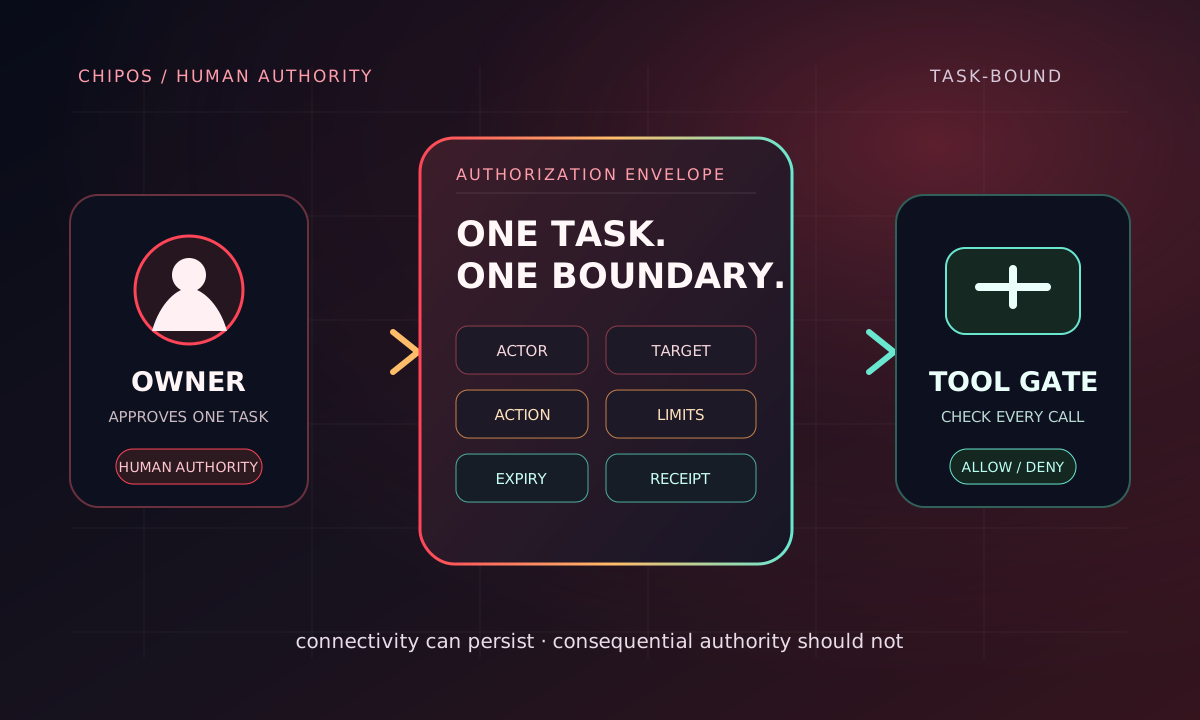
The proposed ChipOS rule is narrower: durable connectivity may remain, but consequential authority should be minted for a specific task and should close when that task is complete, stopped, expired, or materially changed.
Essay
Three different questions must stay separate
Identity, capability, and task authority are related, but they are not interchangeable. A reliable control layer evaluates all three before execution instead of compressing them into one green light.
- Identity: which authenticated owner, service, worker, or delegated actor is involved?
- Capability: what can the connected client and tool technically request or perform?
- Task authority: what did the owner approve for this task, target, consequence, and time window?
Essay
What a task-scoped authorization envelope contains
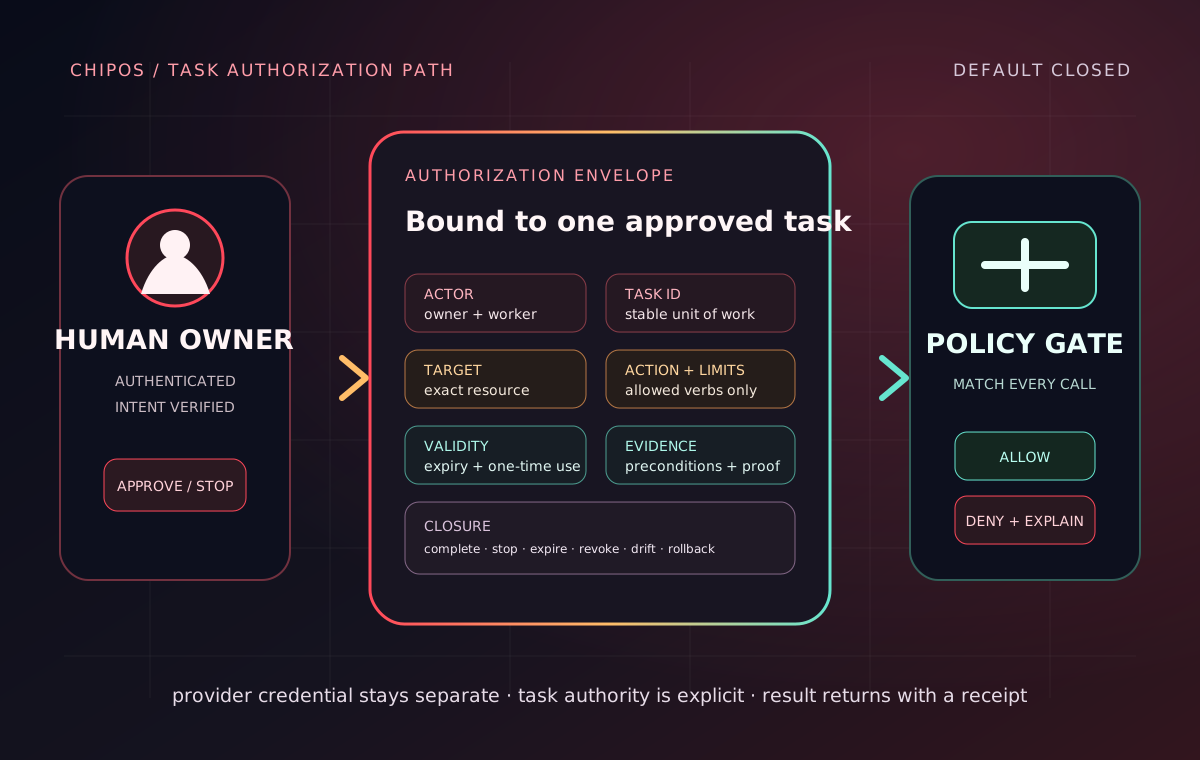
An authorization envelope is a proposed ChipOS control record, not a new OAuth standard. It sits above provider credentials and below the conversational request. Its job is to convert verified human intent into a structured boundary that a worker and tool gateway can enforce.
The envelope should be small enough to inspect and strict enough to fail closed. It may reference private evidence, but it should not become a dump of raw conversation or secrets.
- Actor: the authenticated owner and the worker acting on the owner's behalf.
- Task ID: one durable identifier for the approved unit of work.
- Target: the exact site, account, repository, file, recipient, record, or environment.
- Allowed action: the verbs the worker may perform, such as read, draft, publish, deploy, or revoke.
- Limits: quantity, spend, path, environment, recipient, data class, or other consequence boundary.
- Approval state: who approved the action, through which trusted path, and whether another review gate remains.
- Validity: start, expiry, one-time-use rule, and the events that close or revoke authority.
- Evidence and receipt: the facts required before action and the result that must be returned afterward.
Essay
OAuth can carry finer-grained rights, but the owner still needs a task boundary
OAuth scopes often describe categories of access. RFC 9396 adds an authorization_details parameter for fine-grained authorization data, including actions and locations, and allows a resource owner to grant a subset of what was requested. It also requires the authorization server to associate the granted details with the resulting access token and make them available to the resource server for enforcement.
Cloudflare's optional-scope implementation is a current vendor example of narrowing an authorization flow around the task at hand. Its consent screen can let a user deselect optional scopes, and the resulting access token contains only the scopes the user approved. Cloudflare also tells client developers to inspect the granted scope set rather than assume every requested permission was accepted.
These mechanisms improve technical authorization. They do not, by themselves, define a personal-AI task identity, prove that the current conversational instruction is valid, or decide when a business operation is complete. The owner-controlled envelope supplies that operational layer without pretending the underlying standards promise more than they do.
Essay
Check authority again at the tool boundary
A consent screen is not the last control point. The worker may plan several steps, retry after a timeout, switch tools, or encounter a different target than the one the owner approved. The enforcement gateway should compare every consequential tool call with the current envelope before releasing it.
Current MCP authorization guidance requires protected servers to validate that access tokens were issued for them as the intended audience and forbids accepting or passing through unrelated tokens. RFC 9700 likewise recommends audience restriction so a captured token cannot simply be replayed at another resource server. Those are token-level protections. The ChipOS gate adds task-level checks such as target equality, allowed verb, quantity limit, approval state, and expiry.
If the call falls outside the envelope, the worker should not broaden the record on its own. It should stop, explain the changed consequence, and request the smallest additional decision that would resolve the boundary.
Essay
Concrete workflow: publish one approved website article
Suppose the owner approves publication of one reviewed article to one production website. The personal AI already has a valid deployment connection, but the control layer still creates a new task envelope. It names the production site, the article slug, the source files allowed to change, the single-build limit, the backup and rollback requirements, and the evidence required before public release.
During preparation, read-only source inspection is allowed. A request to change the global layout, analytics, another article, or a second website fails the target and action checks. If the live source differs from the reviewed working copy, the envelope does not authorize the worker to overwrite that drift; the task pauses for a new decision.
After deployment, the system verifies the title, H1, canonical URL, article body, cited evidence, sitemap or feed entry, homepage, and an unrelated protected article. Only then does it close the task as completed and attach the public URL, deployed identity, backup, rollback command, and canary results to the receipt. If verification fails, the approved action is rollback, not improvisation.
Essay
Expiry is necessary, but completion is evidence-based
A short expiry reduces the period in which stale authority can be reused. The current MCP authorization specification requires invalid or expired tokens to receive an HTTP 401 response, while RFC 9700 explains how audience restriction limits where a token can be used. Neither rule proves that a business task succeeded.
The envelope therefore closes through one of several explicit events: verified completion, owner stop, expiry, revocation, target drift, or failed verification followed by rollback. Time can end authority, but it cannot manufacture a successful result.
Retries deserve special care. A timeout creates an unknown outcome, not automatic permission to repeat the action. Before retrying, the worker should inspect the target system for a receipt or changed state. If the first attempt may already have succeeded, the envelope remains closed to a duplicate write until that uncertainty is resolved.
Essay
Implementation pattern for an owned control layer
The pattern can be implemented without embedding every decision in a model prompt. Keep authority in structured state that deterministic components can evaluate and that the owner can inspect.
- Intent verifier: resolves task, target, consequence, authority, and success condition from the human request.
- Policy decision point: creates or denies the task envelope from authenticated owner rules and current evidence.
- Credential broker: keeps provider tokens separate from prompts and releases them only to an approved tool path.
- Policy enforcement point: checks every consequential tool call against the active envelope.
- State observer: verifies whether the target changed, the action completed, or the result remains unknown.
- Receipt writer: records the request, decision, action, evidence, result, expiry, and rollback reference without storing unnecessary secrets.
- Owner stop control: revokes the active envelope, prevents new starts, and distinguishes stop requested from stop confirmed.
Essay
A practical implementation checklist
Begin with one consequential workflow and keep the first envelope deliberately narrow. The objective is not more autonomy. It is clearer human authority at the moment software can change the world outside the conversation.
- Separate account authentication from permission to execute a current task.
- Give every consequential task a stable identifier and an explicit owner.
- Bind actions to exact targets and resource audiences rather than broad service names.
- Represent approved verbs, limits, expiry, revocation, and one-time-use rules in structured data.
- Keep credentials out of prompts, receipts, and raw conversation logs.
- Validate the envelope at the final tool boundary, not only during planning.
- Require a new decision when the target, consequence, data class, or action set changes materially.
- Treat timeouts and missing receipts as unknown outcomes before considering a retry.
- Close authority on completion, stop, expiry, revocation, drift, or failed verification.
- Return a compact receipt that lets the owner reconstruct what was allowed and what actually happened.
Essay
What task-scoped consent cannot guarantee
A narrow envelope cannot prove that a model interpreted the request correctly, that a provider enforces every claim as intended, or that a compromised tool will behave honestly. It does not replace secure token storage, provider-side access control, input validation, audit review, or human judgment for high-consequence work.
It also cannot convert vague authority into certainty. When the owner, target, consequence, or permission source is unclear, the correct state is unresolved. The system should ask one focused question or remain closed.
The useful promise is bounded: a durable connection is no longer treated as unlimited permission, and the owner receives an inspectable record linking one approved task to one enforced action and one verified outcome.
What to keep
The residue.
- Authentication, technical capability, and task authority are different controls.
- Use a short-lived authorization envelope to bind actor, task, target, action, limits, expiry, evidence, and revocation.
- Enforce the envelope at the tool boundary instead of relying on conversational context alone.
- Audience-restricted and fine-grained OAuth permissions strengthen the channel but do not define task completion.
- Close authority only with an explicit event and return a receipt for the verified result.
Operator view
Turn the essay into a company decision.
FAQ
Short answers for search and operators.
Is a task authorization envelope the same as an OAuth access token?
No. An OAuth token is a provider-recognized credential. The proposed ChipOS envelope is an owner-controlled operational record that decides whether a worker may use an available credential for one task, target, action set, and validity period.
Should every read-only action require a new approval?
Not necessarily. The owner can define durable low-risk read policies. A new decision is most important when ambiguity changes the target, consequence, privacy boundary, external side effect, or authority to act.
Does a short-lived token make an agent safe?
No. It narrows one security exposure. Safe operation still depends on correct intent verification, resource and scope validation, secure storage, trustworthy tools, evidence checks, human controls, and honest handling of unknown outcomes.
What happens when the task changes halfway through?
If the target, action, limit, consequence, or evidence requirement changes materially, the current envelope should fail closed. The system can present the delta and request a new or amended authorization rather than silently expanding its own permission.
Sources
Where this connects inside ChipOS.
- RFC 9396: OAuth 2.0 Rich Authorization RequestsPrimary IETF standard for carrying fine-grained authorization data such as actions and resource locations in OAuth messages. It does not define the ChipOS task envelope or guarantee correct human intent.
- RFC 9700: Best Current Practice for OAuth 2.0 SecurityPrimary IETF security guidance used here for audience restriction and token-handling boundaries. It does not prove application-level task completion.
- Model Context Protocol Authorization SpecificationCurrent primary MCP specification for HTTP transport authorization, least-privilege scope selection, token audience validation, expiry handling, and step-up authorization. Authorization is optional for MCP implementations and transport-specific rules apply.
- Cloudflare: From all-or-nothing to task-based OAuth consentVendor implementation example showing optional scopes, user-selected partial grants, and the need for clients to inspect the granted scope set. It is not evidence that every OAuth provider or AI agent behaves this way.
Across the ecosystem
Comments
Leave a signal for Chip.
Add a correction, operator note, source context, or practical consequence. Comments enter moderated review before they become public.