
Essay
A green dashboard can still describe the wrong outcome
The service responded. The event arrived. The trace completed. The page returned 200. Every technical signal may look healthy while the human's actual request remains unfinished.
That gap matters more as personal AI moves from answering questions to changing files, sending messages, updating records, and operating live systems. Once an agent can act, observability is necessary. But observability alone is not proof that the action was authorized, correctly scoped, or useful to the person who asked for it.
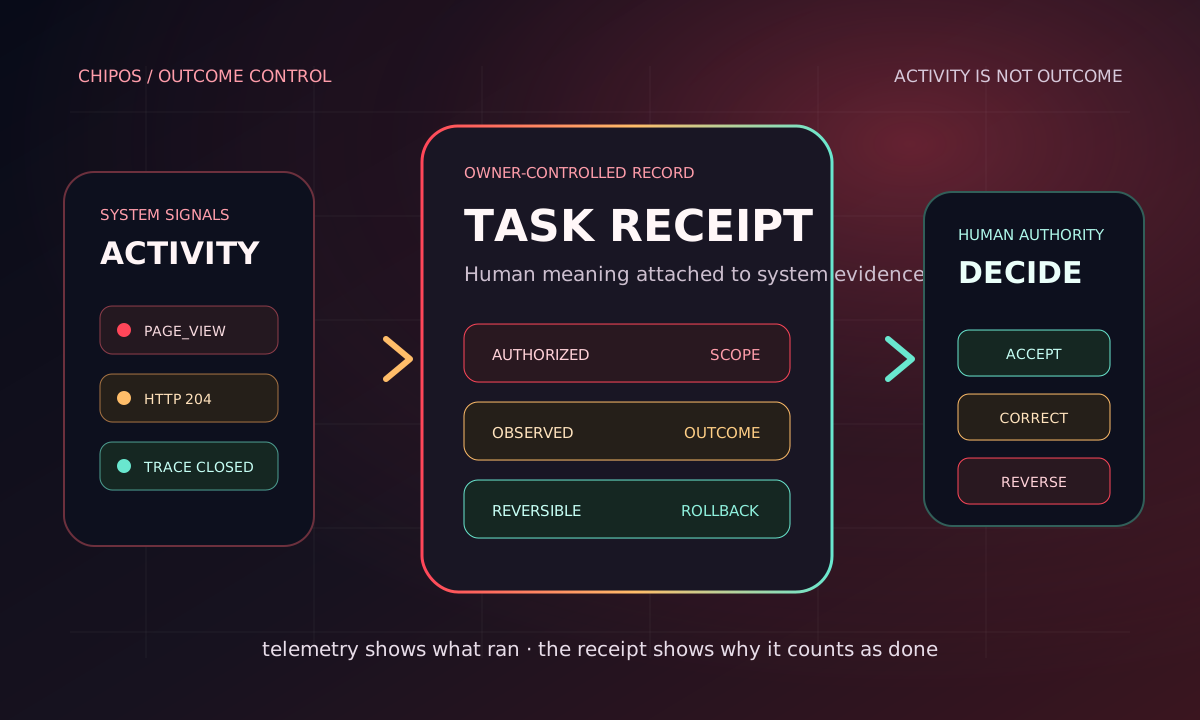
ChipOS proposes a separate operating layer: the task receipt. A task receipt is not another log line. It is a compact, owner-controlled record that connects human intent to the action boundary, observed outcome, protected canaries, and recovery path. It makes completion challengeable without pretending that any record can guarantee universal correctness.
Essay
Activity and completion are different facts
Google Analytics documents that a standard web tag can automatically send a page_view when a page loads or the browser history changes. Google also explains that a 200 or 204 response from its collection endpoint indicates successful event transmission.
Those are useful facts. They can verify that measurement code fired and that the analytics service received the event. They do not, by themselves, establish that the owner chose the right target, that the authoritative source was updated, that unrelated routes stayed intact, or that the intended business outcome occurred.
The event is evidence of transmission. It is not complete evidence of the owner's outcome. The same distinction applies to agentic work: a tool call can succeed while the task fails, a file can be edited while production remains unchanged, and a deployment can finish while the wrong route is live.
- Started: the system accepted a candidate task.
- Executed: an action was attempted inside the boundary.
- Observed: technical evidence shows what the instrumented system did.
- Completed: the intended result was verified on the right target and returned to the owner with a recovery path.
Essay
Telemetry is essential, but it answers a different question
OpenTelemetry describes telemetry as data emitted from systems and applications. Its signals include traces, metrics, logs, and contextual baggage. A span represents one unit of work or operation, while a trace records the path of a request through one or more services.
These signals are indispensable for debugging, reliability work, performance analysis, and incident response. They can show which service handled a request, where an error occurred, how long an operation took, and which downstream dependency participated.
But telemetry describes system activity. Human authority and intended outcome are application-level facts. They appear in telemetry only when the workflow deliberately models and protects them. That is the missing design decision.
Essay
Keep four evidence layers separate
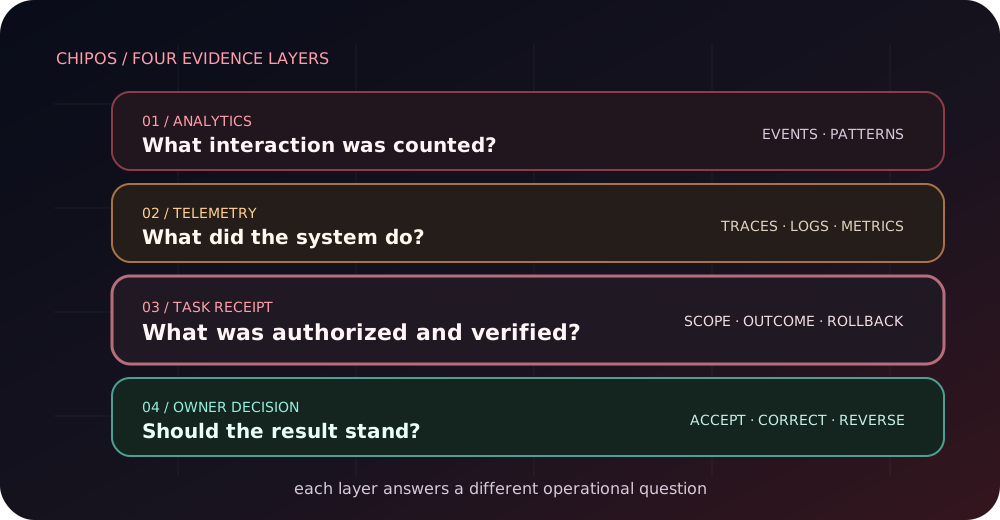
An owned personal AI should not flatten every signal into one claim of success. Analytics, telemetry, the task receipt, and the owner decision have different units and different authority.
- Analytics asks what interaction was counted. Its natural unit is the measured event across users and time.
- Telemetry asks what the system did. Its natural unit is application and infrastructure behavior.
- The task receipt asks what was authorized and verified. Its natural unit is the bounded human task.
- The owner decision asks whether the result should stand, be corrected, or be reversed.
Essay
Concrete workflow: add analytics to one live website
Consider the instruction: add this analytics tag to the website. An execution-only agent may insert the script, see a successful build, and report completion. An observable agent may go further: it can confirm that the browser loaded the script, a collection request returned 204, and no JavaScript error appeared. Those are valuable technical signals.
An owner-controlled agent still needs to verify the exact live application, authoritative source, approved scope, source and runtime state, duplicate-tag risk, repository persistence, protected routes, and recovery path. The 204 remains part of the evidence. It simply occupies the right place in the stack: successful event transmission, not universal task completion.
- Target: the named live application and its authoritative global layout.
- Scope: one analytics configuration and the network policy it requires; no design or content changes.
- Authority: explicit permission for the live target and the repository change.
- Outcome: the intended measurement ID initializes in a real browser and sends an accepted event.
- Persistence: the canonical source retains the same narrow change.
- Protection: an unrelated route remains healthy and visually intact.
- Recovery: the exact narrow change can be reverted through the established deployment path.
Essay
What a useful task receipt keeps
A receipt should be brief enough to review and structured enough to compare. It is deliberately different from a raw trace export. A trace may be attached as evidence, but the receipt preserves the human meaning of the task.
The receipt should also expose uncertainty. Reporting dashboards may process later, external systems may settle asynchronously, and a successful event does not prove every conversion or downstream outcome. Those limits belong in the record instead of being hidden behind the word done.
- Authenticated owner or delegated actor and one durable task ID.
- Exact target, allowed actions, excluded actions, and authority source.
- Before state, action taken, and observed after state.
- Success condition, verification evidence, and protected canary result.
- Remaining unknowns, reporting delays, and external dependencies.
- Rollback, correction, or escalation path.
Essay
Reference telemetry instead of copying every log
The answer is not to copy every log line into a permanent record. That creates noise, increases retention risk, and makes review harder. A task receipt should contain the minimum evidence needed to reconstruct the decision: stable trace or event references, artifact versions, verified success conditions, actor and time, exceptions, and recovery.
Detailed telemetry can remain in the appropriate observability system under its own retention and access rules. The receipt stores the decision boundary and the pointers needed for later inspection.
This separation also supports portability. If the analytics vendor, model provider, or tracing backend changes, the owner can retain the task history without exporting an entire proprietary dashboard.
Essay
The receipt belongs in the owned control layer
If the receipt exists only inside one agent conversation, it disappears with the session. If it exists only in a vendor dashboard, it may become inaccessible when the account, plan, or platform changes.
ChipOS proposes keeping the receipt in the operator's control layer, alongside scoped permissions, workflow memory, approvals, and recovery references. That does not require every model or tool to be self-hosted. External systems can still execute useful work.
The ownership requirement is narrower and more practical: the operator should retain enough structured evidence to understand what was authorized, what happened, and how to recover.
Essay
Implementation checklist for one consequential workflow
Start with one workflow where a false claim of completion would matter. Keep the first receipt small enough that an operator can inspect every field and challenge every transition.
- Define a task identifier before execution and bind it to an authenticated human and active workspace.
- Record the exact target, authoritative source, allowed actions, exclusions, and success condition.
- Capture relevant trace, log, event, file-hash, test, or deployment references.
- Verify the intended outcome, not only the tool response or HTTP status.
- Run at least one protected canary when the action can affect shared systems.
- Record unknowns, asynchronous reporting delays, and external dependencies honestly.
- Store a correction or rollback path and return the receipt in plain language.
- Keep credentials, raw private prompts, and unrelated conversation out of the receipt.
Essay
What a task receipt cannot guarantee
A receipt can be incomplete, misleading, or built from faulty sensors. A trace can miss an operation. A test can check the wrong condition. A human can approve a poor decision. An external service can report success and process the action differently later.
This framework does not guarantee safety, truth, or correct intent. It improves inspectability by forcing the workflow to expose its task boundary and verification basis.
For irreversible, regulated, financial, medical, or high-impact actions, additional controls and qualified human review may be required. A compact receipt is an operating aid, not a substitute for legal duties, professional judgment, or domain-specific assurance.
Essay
The owner should be able to challenge done
Personal AI becomes useful when it can act without making the human supervise every mechanical step. It becomes trustworthy only when the human can still challenge the result.
Telemetry helps reconstruct what the system did. The task receipt reconnects that activity to authority, scope, outcome, and recovery. Together they make autonomous work more inspectable. Separately, they answer different questions.
The final test is simple: can the system show not only that it ran, but why this exact result was allowed to count as done? If it cannot, the task may be observable. It is not yet owned.
What to keep
The residue.
- Analytics records measured interactions; telemetry records system activity; neither automatically proves the human's intended outcome.
- A ChipOS task receipt connects authority, scope, action, verification, protected canaries, unknowns, and rollback.
- The receipt should reference detailed telemetry instead of copying every log into a permanent record.
- A successful tool response or event transmission is evidence, not universal completion proof.
- The owner must retain the ability to inspect, correct, reject, or reverse the result.
Operator view
Turn the essay into a company decision.
FAQ
Short answers for search and operators.
Is a task receipt the same as an audit log?
No. An audit log typically records events or state changes. A task receipt binds selected evidence to the human task, authority boundary, success condition, observed result, and recovery path. An audit log may be one of its evidence sources.
Does a successful trace mean the AI task succeeded?
It can show that the instrumented operations completed as recorded. It does not automatically prove that the human authorized the action or that the intended business outcome occurred. Those facts need explicit workflow context and verification.
Should the receipt contain every prompt and log line?
No. It should preserve the minimum evidence needed to reconstruct the decision while excluding credentials, private conversation, and unrelated data. Detailed telemetry can remain in its governed observability store.
Can receipts guarantee safe AI actions?
No. Receipts can also be incomplete or wrong. They improve inspectability and correction by making the claimed basis for completion visible.
Sources
Where this connects inside ChipOS.
- Google Analytics: Measure pageviewsPrimary Google developer documentation used for automatic page_view behavior on page loads and browser-history changes. It does not claim that a pageview proves task completion.
- Google Analytics: Verify and troubleshoot your setupPrimary Google developer documentation used for browser-network verification and the meaning of a 200 or 204 collection response as successful transmission. The task-completion distinction is ChipOS interpretation.
- OpenTelemetry: SignalsPrimary OpenTelemetry documentation used for the distinction between traces, metrics, logs, and contextual baggage.
- OpenTelemetry: Observability primerPrimary OpenTelemetry documentation used for span and trace definitions and for the difference between emitted activity and user-facing reliability.
Across the ecosystem
Comments
Leave a signal for Chip.
Add a correction, operator note, source context, or practical consequence. Comments enter moderated review before they become public.