
Essay
Fluent analysis can hide an evidence failure
A general-purpose agent can appear coherent while quietly changing the meaning of its inputs. A detection becomes proof. A missing lookup becomes no result. A convenient time range replaces the approved one. By the time the answer arrives, the system has compressed collection, interpretation, and decision into one fluent story.
Cloudflare described this failure in an October 2026 account of an early security-operations harness. Its first single-agent prototype produced useful analysis but also unsupported claims. Cloudflare identified three recurring problems: context became authority, scope drifted, and failed lookups became difficult to distinguish from completed checks with no match.
That is a useful engineering lesson beyond security operations. The problem is not only model quality. It is architecture. If the same probabilistic component can select evidence, alter scope, hide retrieval failure, interpret findings, and recommend action, a stronger prompt still leaves too many controls inside the inference step.
Essay
Define the evidence boundary before the model sees the task
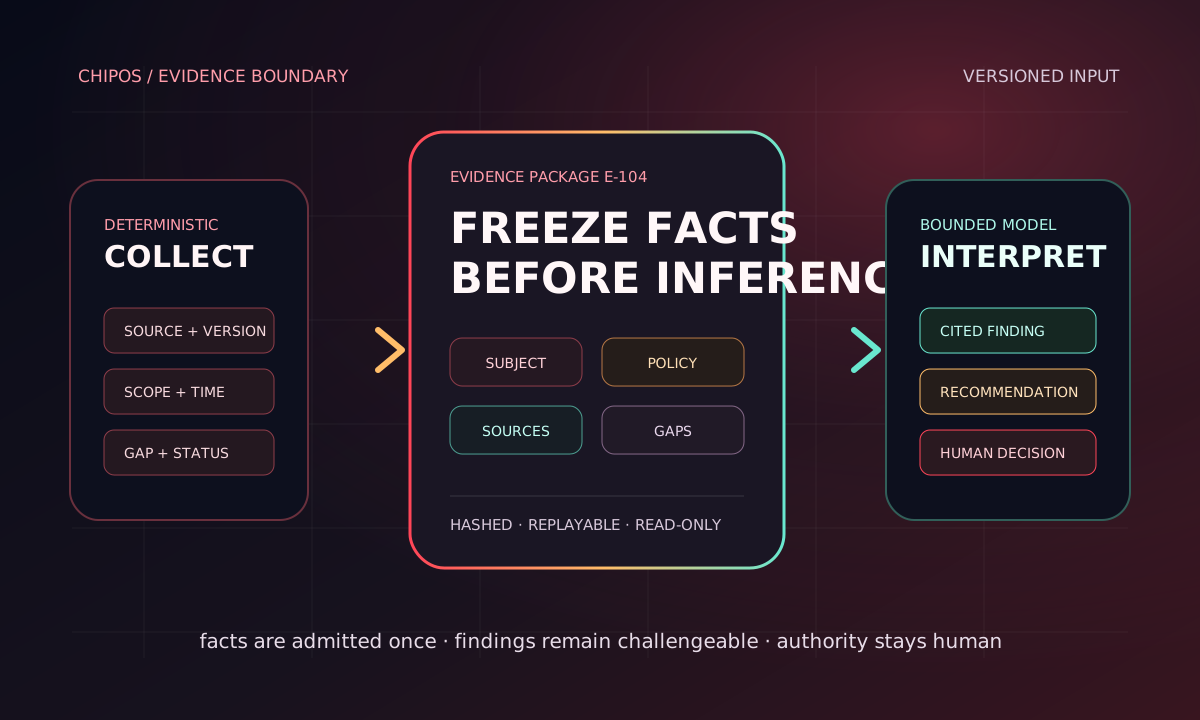
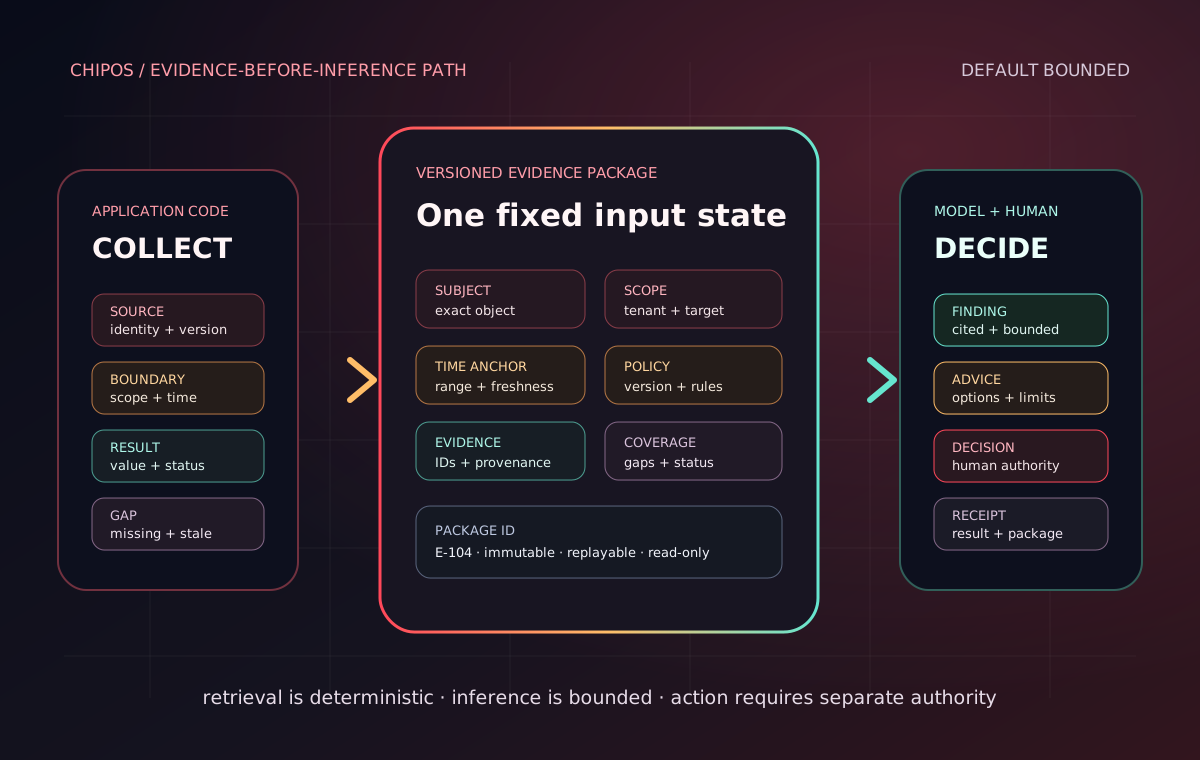
An evidence boundary is a proposed ChipOS operating pattern. It is the deterministic layer that decides what information belongs to this task before any model is asked to reason over it. The boundary does not decide the business outcome. It creates the smallest inspectable package from which a finding may be made.
The package should be versioned and immutable for the duration of one evaluation. If new evidence arrives, the system creates a new package or a documented revision instead of silently changing the inputs beneath an existing conclusion.
- Subject: the exact account, system, record, customer, case, or asset under review.
- Scope: the approved tenant, workspace, route, repository, dataset, and action boundary.
- Time anchor: the start, end, timezone, collection time, and freshness threshold.
- Admitted evidence: the records allowed into this evaluation and why they qualify.
- Policy versions: the rules, thresholds, taxonomies, and control versions that apply.
- Coverage gaps: failed, unavailable, excluded, stale, or unresolved sources that limit the result.
Essay
Collect first. Freeze second. Infer third.
Cloudflare's published design moves reconnaissance and scope enforcement into application code before model analysis. Deterministic workflows collect a fixed set of data with source, version, and timestamp, then produce a snapshot that can be replayed. Its synthesis agent combines typed findings but cannot fetch new evidence or choose a classification outside the approved vocabulary.
ChipOS generalizes that idea as an owner-controlled sequence. Deterministic collection establishes what is knowable for this run. A package hash or version identifies the exact input state. Specialist or general models then produce findings against that fixed package. Application code validates references and rejects claims that point outside it. The owner or accountable operator keeps authority over the consequential decision.
This separation does not make the model correct. It makes the basis of the answer visible, testable, and replayable without allowing a later retrieval change to masquerade as a reasoning change.
Essay
Keep evidence, findings, recommendations, and decisions separate
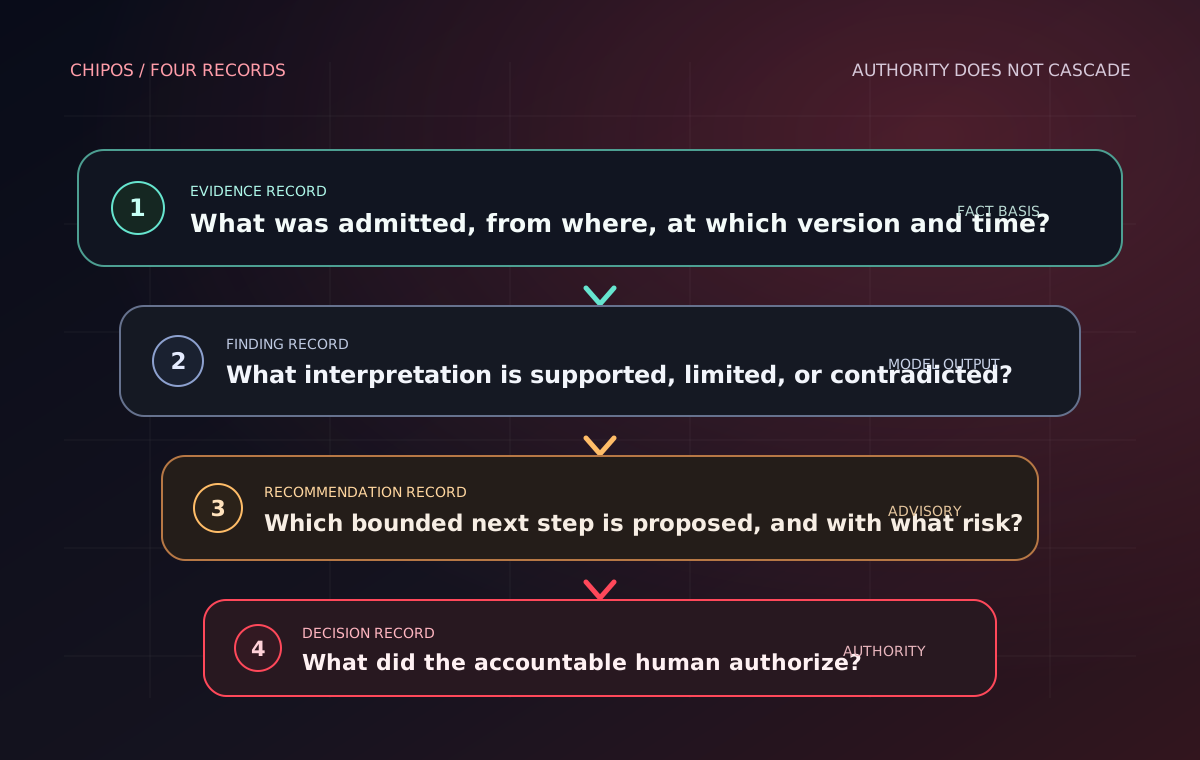
A durable workflow should not store one undifferentiated AI answer. It should keep four records with different authority. Evidence is what the system admitted. A finding is an interpretation supported by references to that evidence. A recommendation proposes a bounded next step. A decision belongs to the authorized human or deterministic policy gate.
The distinction matters during review. A later operator can challenge a finding without rewriting the source record, reject a recommendation without erasing the analysis, or revise a decision when a new evidence package changes the facts.
- Evidence record: source ID, version, timestamp, collector, integrity reference, and admitted scope.
- Finding record: claim, cited evidence IDs, confidence or limitation, model and prompt version, and validation state.
- Recommendation record: proposed action, target, expected effect, risk, alternatives, and required approval.
- Decision record: accountable actor, accepted or rejected action, reason, time, authority, and resulting receipt.
Essay
Missing evidence needs a typed state
Unknown is not one state. A source may never have been checked, a completed lookup may return no matching record, or the available evidence may actively support absence. Flattening those cases into no evidence encourages overconfident conclusions.
Cloudflare's implementation explicitly distinguishes not checked, checked with no match, and checked with evidence supporting absence. That is a strong general control pattern. The system can still produce a bounded finding when some sources are unavailable, but it must carry the gap forward and refuse conclusions that depend on the missing source.
- Not checked: no collection attempt completed, so no claim about presence or absence is supported.
- Checked, no match: the lookup completed within a declared scope and returned no matching result.
- Evidence supports absence: positive evidence or complete coverage supports the bounded absence claim.
- Unavailable or stale: the source exists but could not support the current time, scope, or freshness requirement.
Essay
Concrete workflow: investigate one access anomaly
Consider a company using a personal AI to help investigate an unusual access event. The owner does not ask the model to search every connected system and decide whether an account is compromised. The control layer first binds the task to one identity, one environment, one time window, and one approved set of read-only sources.
Deterministic collectors retrieve the authentication event, relevant session history, policy version, device or network observations that the company is authorized to use, and the result of each lookup. The system freezes those records into evidence package E-104 and records any source that failed or remained outside permission.
The model may then produce a finding such as: the sign-in differs from the account's recent pattern, the current evidence does not show a successful privileged action, and one device source was unavailable. It may recommend a bounded review step. It may not label the account compromised, expand the time range, revoke access, or message the user unless a separate policy or human decision authorizes that action.
The receipt links the final decision to package E-104. If a new log source arrives later, the system creates E-105 and marks any changed finding as a revision rather than silently rewriting history.
Essay
Provenance makes the package reconstructable
The W3C PROV-O recommendation models provenance through entities, activities, and agents. A team does not need to implement the full ontology to use the underlying discipline: record what object was used, which activity transformed or generated it, and which human or software actor was responsible for that activity.
For an evidence-bounded agent, those relationships can be compact. Source records are entities. Collection, validation, inference, and decision are activities. Collectors, models, operators, and approving humans are agents with declared roles. The result is a chain that can be reconstructed after a provider, model, or workflow changes.
Provenance is not proof that a claim is true. It is proof of lineage: where the material came from, how it changed, and who or what participated. Correctness still requires domain validation and accountable review.
Essay
Replay the package, not the live world
Evaluation becomes clearer when the same evidence package can be replayed. Two model versions can analyze identical inputs, allowing the operator to compare differences in interpretation instead of wondering whether each agent retrieved a different world.
A replay should remain read-only. It may generate a new finding record, but it should not mutate the original evidence package, repeat external actions, or inherit the authority of the original decision. If the workflow needs current facts, create a fresh package and compare it with the earlier one.
This also improves incident review. The team can reproduce what the system knew at the time without pretending that later evidence was available earlier.
Essay
NIST supports the risk boundary, not this exact architecture
NIST's Generative AI Profile defines confabulation as confidently presented erroneous or false content, including output that diverges from prompts or contradicts earlier statements. It recommends reviewing and verifying sources and citations, documenting content lineage, and defining human-AI roles and oversight.
Those recommendations support evidence-aware controls, but NIST does not prescribe this exact ChipOS pattern or certify that an evidence package makes an agent safe. The architecture here is a practical design proposal that applies those risk boundaries to an owned operating layer.
Essay
Implementation checklist for one bounded agent workflow
Start with one consequential workflow where a wrong scope or hidden evidence gap would matter. Keep the first implementation small enough that an operator can inspect every state transition.
- Define the task subject, target, scope, time anchor, and authorized sources before inference.
- Collect evidence through deterministic code with source, version, timestamp, and explicit error state.
- Freeze a versioned package and prevent models from adding unrecorded evidence during synthesis.
- Require findings to cite admitted evidence IDs and reject references outside the package.
- Represent missing, stale, excluded, and unavailable evidence as typed states.
- Keep evidence, findings, recommendations, and decisions as separate records.
- Restrict recommendation vocabulary and action targets where the workflow supports it.
- Keep credentials and unnecessary private data out of prompts and public receipts.
- Require an authorized human or deterministic policy gate for consequential action.
- Return a receipt linking the decision and observed result to the exact evidence-package version.
- Replay packages for evaluation without replaying the original side effects or authority.
Essay
What an evidence boundary cannot guarantee
An evidence boundary cannot guarantee complete data, correct collection, honest sources, sound model reasoning, or a good human decision. A compromised collector can still admit false records. A narrow package can omit decisive context. A cited statement can still misuse the cited evidence.
It also does not replace authentication, least privilege, secure execution, privacy controls, testing, incident response, or domain expertise. Cloudflare's described system is an early beta and a vendor account of its own implementation, not independent proof that the pattern eliminates security failures.
The bounded promise is more modest: the system stops treating a fluent model response as self-justifying. It gives the owner a fixed input record, visible gaps, challengeable findings, and a separate decision boundary before action moves.
What to keep
The residue.
- Move evidence collection and scope enforcement into deterministic application code before inference.
- Freeze a versioned package so model evaluations can be replayed against the same facts.
- Keep evidence, findings, recommendations, and human decisions as separate records.
- Treat missing evidence as explicit typed states instead of flattening every gap into no result.
- An evidence boundary improves inspectability; it does not guarantee correctness or safety.
Operator view
Turn the essay into a company decision.
FAQ
Short answers for search and operators.
What is an evidence boundary for an AI agent?
It is a deterministic operating layer that fixes the task subject, scope, time, admitted sources, policy versions, and visible gaps before model inference. The model reasons over that versioned package instead of selecting and changing its own evidence during synthesis.
Is an evidence boundary the same as retrieval-augmented generation?
No. Retrieval can supply context, but an evidence boundary also controls scope, source admission, versions, failure states, provenance, citation validation, replay, and the separation between findings and decisions.
Why should the evidence package be immutable?
A fixed package lets operators reproduce what the model knew for one evaluation. New facts should create a documented revision so changed evidence is not confused with changed reasoning.
Does cited evidence prove an AI finding is correct?
No. Citations make a claim challengeable, but the model may still misinterpret the source or omit relevant context. Application checks and human domain review remain necessary.
Who should make the final decision?
For consequential work, the accountable human or an explicitly authorized deterministic policy gate should decide. A model recommendation should not silently become permission to act.
Sources
Where this connects inside ChipOS.
- Cloudflare: Building an evidence-grounded agentic security operations harnessPrimary vendor engineering account published 7 October 2026. Used for the single-agent failure modes, recon-before-inference architecture, versioned evidence package, typed findings, explicit evidence gaps, and retained analyst responsibility. It describes an early beta and is not independent proof of safety or performance.
- NIST AI 600-1: Generative Artificial Intelligence ProfilePrimary NIST profile used for the confabulation definition and recommendations around source verification, content lineage, human-AI roles, monitoring, and provenance. It does not define or certify the proposed ChipOS architecture.
- W3C PROV-O: The PROV OntologyW3C Recommendation used for the provenance distinction among entities, activities, and agents and the relationships that support reconstructable lineage. Implementing the full ontology is optional for this pattern.
Across the ecosystem
Comments
Leave a signal for Chip.
Add a correction, operator note, source context, or practical consequence. Comments enter moderated review before they become public.